
Local experts and residents press council to scrutinize proposed Mid‑Atlantic Resiliency Link transmission line
Get AI-powered insights, summaries, and transcripts
Subscribe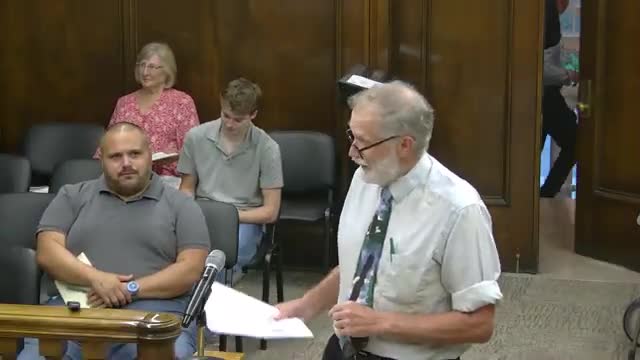
Summary
A volunteer Green Team chair briefed council on the Mid‑Atlantic Resiliency Link (M.A.R.L.), warning of uncertain greenhouse‑gas impacts, visual and land‑use effects, and potentially large statewide ratepayer costs if the project increases fossil‑fuel generation use.
Jim Coatsen, chair of Morgantown’s volunteer Green Team, gave a technical briefing to Morgantown City Council on Aug. 26 about the proposed Mid‑Atlantic Resiliency Link, a high‑voltage transmission proposal being developed by NextEra Transmission and other utilities that would cross parts of West Virginia en route to data‑center demand in Northern Virginia.
Coatsen described the project as a response to transmission bottlenecks identified by PJM Interconnection and noted the line’s purpose would be to move large volumes of power from the Ohio Valley eastward. He said the project could both enable renewable interconnections and — depending on how generation is dispatched — could result in increased operation of fossil‑fuel plants.
“If on the other hand, it simply expedites through the use of coal‑fired power plants then our greenhouse gas impacts would go up dramatically,” Coatsen said, summarizing the central uncertainty. He said critical technical data about power flows and which plants would be dispatched are not publicly available now and that intervenor discovery at state public‑service commissions may supply some of that information.
Coatsen listed potential local impacts: transmission towers could cross public lands including Cooper’s Rock and, on some routing options, even the Appalachian Trail; wetlands in Maryland could be affected; private landowners could see additional transmission easements; and energy‑cost allocations could mean West Virginia ratepayers fund part of the $940 million‑plus project. Coatsen cited a figure estimating West Virginia’s share at roughly $184 million over 40 years under current cost allocation rules.
He recommended the council review any final applications submitted to state regulators and consider intervening or submitting comments to the Public Service Commission and governor’s office. Judy Delagarza, a Morgantown resident who spoke during public comment, said Potomac Edison has filed a letter of intent tied to a portion of the proposed route and urged residents to send letters to the governor and the West Virginia Public Service Commission. "The clock is of the essence," Delagarza told council, urging broad community engagement.
Councilors asked technical and jurisdictional questions about how transmission is planned and whether West Virginia would receive direct service from the line. Coatsen said the line’s eastern terminus is in Virginia and that the primary benefit would be to eastern load centers, but he cautioned that precise power flows are difficult to predict without proprietary operational data.
The presentation closed with Coatsen asking the council to examine route filings when NextEra or other utilities submit formal proposals to the state Public Service Commission and to seek offsets for disadvantaged communities and to avoid routing through public lands where possible. The council said it intends to share its recent resolution with the governor and the PSC when filings emerge.
Ending: No formal city action was taken at the meeting; presenters asked the council to review and, if appropriate, file comments with state regulators when formal route and permit applications are posted.