
HCAI outlines Song Brown 2025 application rules, scoring, deadlines and allowable uses
Get AI-powered insights, summaries, and transcripts
Subscribe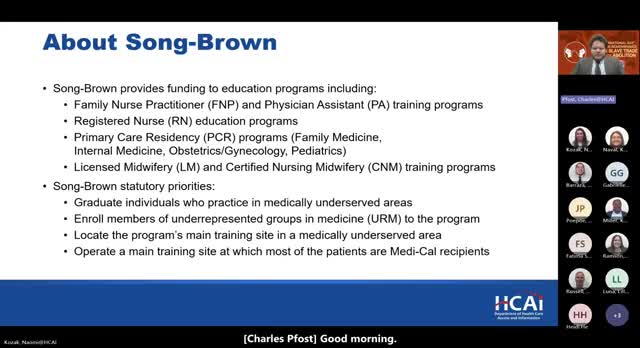
Summary
Health Care Access and Information staff explained Song Brown grant eligibility, eApp requirements, scoring (three equal criteria), and deadlines; clarified allowable uses such as preceptor stipends and first‑year student support, and described CNM expansion rules and required documentation.
California Health Care Access and Information (HCAI) staff used a public webinar to summarize application requirements, scoring methodology and key deadlines for the Song Brown family nurse practitioner (FNP), physician assistant (PA) and certified nurse‑midwifery (CNM) grant programs, and to answer applicants’ procedural questions. HCAI staff urged applicants to gather payer‑mix and training‑site data, confirm organizational authority to sign grant agreements, and use the early‑submission review to correct incomplete applications.
The Song Brown program “provides funding to education programs, including family nurse practitioner, physician's assistant, registered nurse, primary care residency, and midwifery programs,” said Charles Foust, grant officer for the Song Brown FNP/PA program. He told attendees that Song Brown funds “must be used for the direct education and training of students and to help expand primary care services in California. They are not to be used to supplant other governmental funds.”
Why it matters: Song Brown awards supply education funding intended to expand primary‑care capacity in underserved communities; scoring decisions determine which programs receive those funds. HCAI said accurate training‑site payer‑mix data and graduate practice locations are central to scoring and to post‑award payment setup.
Most important application requirements and deadlines - Applicants must confirm their organization can enter into a grant agreement with HCAI before applying and ensure IRS and accounting information in the eApp matches organizational records. Only the designated grant director can submit an application; that role can grant preparer access but not submit on another’s behalf. HCAI recommended coordinating with the finance office before applying. - Early submission review is available: HCAI staff will review early submissions and return a list of corrections; applicants may edit after the early review. The early submission deadline for an advisory review is 3 p.m. (local) on Sept. 9; the final submission deadline is 3 p.m. on Sept. 24. HCAI said awards are anticipated to be posted by January 2026. - Use supported browsers (Google Chrome or Microsoft Edge) and complete two‑step verification when registering in eApp. New organizations may take up to five days to be approved in the system.
What to prepare and upload - Training‑site data: Programs must report up to the five primary care training sites where students logged the most cumulative hours, including site NPI, facility type, address, cumulative student hours and the payer‑mix breakdown for each site. HCAI advised applicants to obtain payer‑mix figures directly from training sites’ administrative offices; HCAI staff said payer‑mix figures are not available from a public database. - Graduate data: Applicants should have graduates’ NPI numbers and current practice locations ready; only graduates practicing in California are scored. Graduate entries must match the aggregate graduate counts elsewhere in the application. - Accreditation/approval letters: An accreditation or approval letter is required; expansion approval letters for CNM programs must indicate the number of approved expansion slots. HCAI requires the approval file name to begin with APPR_ to be accepted.
Scoring methodology and CNM expansion rules - For the 2025 cycle, HCAI assigns 75 total points across three equal criteria: percent of graduates practicing in areas of unmet need (25 points), percent of main training sites located in areas of unmet need (25 points) and the average payer mix of those main training sites (25 points). Cassini Nuvall, program officer for CNM, described the scoring example showing each criterion worth 25 points. That structure means payer mix is one‑third of the total score; the two training‑site criteria together account for two‑thirds of the score. - CNM applicants that have been approved by their accrediting or approval body to expand for the 2025–26 academic year must select the expansion option on the program information page, check the required certification boxes and may request up to three expansion slots if their approval allows it.
Allowable and disallowed expenditures - HCAI repeatedly stated Song Brown funds support direct education and training costs for the students and slots specified in an award. The program permits support for first‑year students and may cover the program’s published maximum slots (applicants should consult the grant guide for slot caps by program type). HCAI stated preceptor stipends are allowable. HCAI staff clarified that fees charged by clinical sites for placement are not allowable; programs may pay preceptor stipends but not placement fees.
Application navigation and technical tips - Save application progress by using the application’s Save and Next button; use Previous to move backward. Fields marked with a red asterisk are required; tooltips appear as a blue circle with a question mark. Contract administration and payment information must match IRS documents (W‑9/STD‑204 equivalents referenced on the eApp). Once an application is certified and submitted, no edits are possible except via the early‑submission correction process described above.
Where to get help - HCAI posted the FNP/PA and CNM grant guides, a technical assistance guide with page‑by‑page screenshots, and webinar recordings on the program pages and in the chat during the session. Staff asked applicants with questions to email songbrown@hcai.ca.gov (address provided in the webinar resources) for follow‑up assistance.
Meeting context and next steps - Presenters spent the webinar walking through the eApp, application requirements and scoring; they answered applicant questions about allowable costs, payer‑mix sourcing and the early‑submission process. HCAI encouraged applicants to read the grant and technical assistance guides, verify organizational signatory authority, collect training‑site payer‑mix data before starting the application and to use the early submission review to resolve missing or erroneous fields.
The application cycle’s early‑review and final deadlines remain the most immediate deadlines for applicants seeking Song Brown funding for FNP, PA or CNM programs.