
District 205 projects tighter FY26 budget as transportation and private tuition reimbursements shrink
Get AI-powered insights, summaries, and transcripts
Subscribe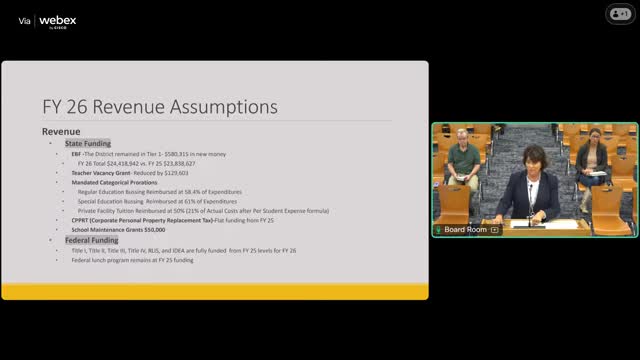
Summary
District staff presented the proposed FY26 budget and warned that reduced state reimbursements for transportation and private special-education tuition, plus rising costs, will increase pressure on local revenues and may require a levy increase for transportation.
A staff member presenting Galesburg Community Unit School District 205’s proposed fiscal year 2026 budget told the board that state and federal revenue changes are compressing the district’s margins and shifting more cost pressure to local taxpayers and reserves. The presenter reviewed evidence-based funding, categorical proration, and expenditure assumptions and outlined possible next steps, including a proposed small levy increase to shore up transportation funding.
The presentation said the district’s evidence-based funding (EBF) allocation rose to $24,400,000 for FY26, an increase of about $580,000 from FY25’s $23.8 million. At the same time, the district expects a $129,000 decrease in its teacher vacancy grant and “substantial prorations” in mandated categorical reimbursements for transportation and private facility special-education tuition. The presenter said the district expects about a 58% reimbursement rate for regular transportation and roughly 61% for special-education transportation in FY26, down from full reimbursement in prior years; private facility tuition reimbursement was estimated at roughly 21% of per-student cost under current pool-and-formula rules.
Why this matters: transportation and out-of-district special-education placements represent significant, mostly fixed costs for the district. The presenter said transportation contracts and costs are rising and that, absent higher local revenue, the district will need to increase local contributions to avoid service reductions.
Key figures and assumptions presented: the district projects $48.2 million in education-fund revenue for FY26, with revenue sources split about 49% state, 39% local, and 12% federal; the district’s budget assumptions include a 3% average salary increase, a 15% budgeted rise in employee benefits (set as a negotiating threshold), and a 5% increase for contracted services, supplies and materials. The presenter also noted flat corporate personal property replacement tax (CPPRT) receipts compared with recent years and a one-time school-maintenance grant program offering $50,000 for qualifying projects.
On federal funding, the presenter said Title I, II, III, IV and IDEA allocations are currently budgeted at FY25 levels for FY26; she cautioned that federal appropriations operate on a different cycle and that program funding could change when the next federal budget is finalized. She also noted school lunch funding is tied to the federal farm bill and said any changes there could affect that program.
Board members asked clarifying questions. The presenter explained the math behind the transportation proration: the state’s transportation reimbursement historically covers 80% of the transportation formula amount, and an additional proration (reported as 75% this year) is applied on top of that, producing an effective 58% reimbursement (75% of 80%). The presenter said the Illinois State Board of Education sets those proration assumptions based on projected state transportation spending and historical cost trends.
Possible board action and next steps: the presenter said she will return with levy-option recommendations; she explicitly said she would propose “slight changes in our levy to increase our local contribution towards transportation” to address the projected shortfall. The board later moved to approve the FY26 District 205 budget (motion recorded and approved by roll call during the meeting).
Ending: the presenter summed up priorities for the district as monitoring transportation reimbursement, managing growing out-of-district special-education costs, and watching price volatility for goods and contracted services that could be affected by tariffs. She urged continued attention to state and federal budget developments that could change assumptions used in the FY26 plan.