
State outlines data‑submission penalties, timeline and enforcement steps; board and public urge tougher sanctions and transparency
Get AI-powered insights, summaries, and transcripts
Subscribe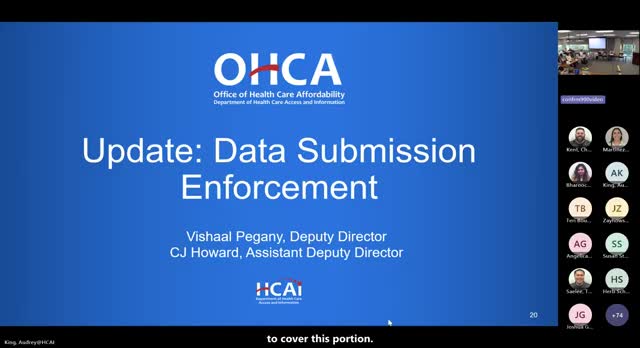
Summary
Assistant Deputy Director CJ Howard presented OCA’s proposed timeline and penalty structure for required data submissions at the Aug. 28 board meeting and asked the board and public for feedback.
Assistant Deputy Director CJ Howard presented OCA’s proposed timeline and penalty structure for required data submissions at the Aug. 28 board meeting and asked the board and public for feedback. CJ Howard said the office will treat data as “acceptable when it is passed automated and manual data validation checks” and described a multi‑step enforcement path that begins with a Sept. 1 submission deadline, allows two optional 15‑day extensions, and provides a five‑day correction window after staff notice of technical defects. CJ Howard said “submitters would be subject to an initial flat untimely data submission penalty of $10,000” and that the office added a second flat untimely penalty of $10,000 if data are not submitted by Nov. 1. He said the office also proposes a separate failure‑to‑submit penalty of $5 per member per year that would double in each subsequent noncompliant year. Why it matters: the Office of Care Affordability and Care depends on timely, complete payer and provider files to measure spending and enforce targets. Staff said average dollar figures for the proposed sanctions would be small relative to some payers’ revenues — CJ Howard reported that $5 per member equates to about 0.07% of a plan’s annual revenue on average — and sought board guidance on whether amounts and timing should be more punitive. Staff outlined the progressive enforcement steps that would begin if data are not submitted by Nov. 1: technical assistance, an optional public‑testimony step, and, if files remain missing 30 days after Nov. 1, a required data‑submission plan with a proposed final delivery no later than Dec. 31 (or another date agreed with the office). If data remain missing after the agreed date, the per‑member failure‑to‑submit penalty would apply. CJ Howard said the office could make assessed penalties public, seek an administrative law judge order to compel data, notify licensing agencies, or pursue superior‑court writs if necessary. Several board members urged a more aggressive schedule or larger penalties. Ian Lewis and other board members warned that small flat penalties can be treated “as a cost of doing business” by large plans; Richard Kronick and Elizabeth Mitchell urged a more progressive, time‑based escalation. Doctor Richard Pan and others emphasized the need to balance support for submitters who act in good faith with stronger measures for repeated noncompliance. Public commenters pushed the office to strengthen the proposal and add transparency. Beth Capelle of Health Access California said the statutory standard for civil penalties depends on proof of “knowing” noncompliance and that a higher standard applies for “willfully” providing inaccurate data; she argued $5 per member is inadequate against insurers whose premium volumes measure in the billions and urged public transparency “at every step.” Janice Rocco of the California Medical Association suggested a test phase (similar to the Health Payments Database rollout) so plans can work out technical issues before the deadline. Other commenters, including Katie Bassler of the Salinas Valley Federation of Teachers, described large premium increases in local markets and said penalties should reflect material consumer harm. Clarifying details from staff and filings: the data submission portal has 51 plans registered to submit data this year; 38 plans had received one‑on‑one technical assistance; 21 plans had submitted test files and six had submitted 2023 production files as of the presentation. The proposed dates are: Sept. 1 submission due date; two optional 15‑day extensions; Nov. 1 begins progressive enforcement and the additional $10,000 untimely penalty; Dec. 31 or an agreed date is the deadline for an approved correction plan. Discussion vs. decision: the board did not vote on penalties; staff treated the presentation as informational and asked for guidance. Staff said the proposal could be adjusted before formal rulemaking. Ending: staff said they will return with refined penalty mechanics; board members encouraged staff to consider monthly escalation and stepped increases that remain meaningful to large plans while allowing time for good‑faith corrections.