
Del Norte supervisors approve short‑term county support to bridge airport invoices; ask staff to study long‑term feasibility
Get AI-powered insights, summaries, and transcripts
Subscribe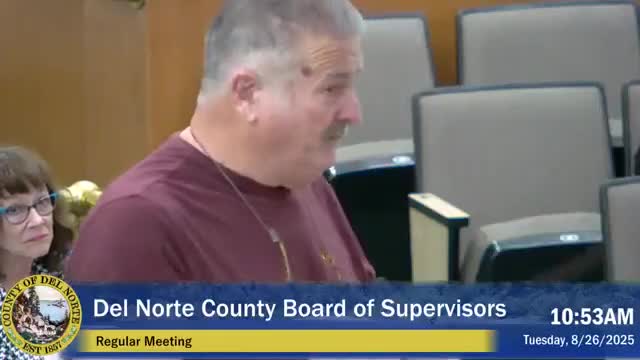
Summary
The board authorized a line of credit to the Border Coast Regional Airport Authority to bridge immediate invoices for runway work, a wildlife‑fence replacement and an ARFF truck, while directing staff to study the joint‑powers authority's long‑term financial structure and set up separate accounting for airport projects.
The Del Norte County Board of Supervisors voted to extend short‑term county financial backing to the Border Coast Regional Airport Authority (BCRAA) so the authority can pay several large, federally funded projects up front and await federal reimbursement.
The board’s action authorizes county bridge financing to cover a set of open airport projects — runway work (project 1836 with earlier invoices totaling about $2.8 million already paid and a second invoice about $3.4 million pending), a wildlife‑fence replacement project estimated at roughly $900,000, and an Aircraft Rescue and Firefighting (ARFF) truck and associated training with invoices near $485,000 — while the authority seeks federal reimbursements (the Federal Aviation Administration typically reimburses about 95% of eligible costs).
Why it matters: The projects are required by federal airport safety standards and have short billing cycles that outpace the authority’s available cash on hand. Without a bridge mechanism, vendors would face delayed payment and mandated safety work could stall.
Board discussion and concerns: Supervisors debated whether the county should provide an open, standing line of credit or restrict county support to the current open projects. Several supervisors and county financial staff urged caution and requested clearer accounting. Auditor‑Controller and county staff described a cash‑flow mismatch: large invoices for federally funded work arrive in a short time window, and BCRAA lacks the bank balances to cover those lump sums before federal reimbursement arrives. County staff described reimbursements from the FAA as generally prompt for AIP grants, while Department of Transportation operational reimbursements can take longer.
Supervisor Howard said the work is federally mandated and “either way, it’s gonna have to be paid,” arguing the county’s low interest rate would be cheaper than outside commercial financing. Supervisor Starkey and others sought limits: they supported financing the immediate, open projects but wanted subsequent projects to return to the board for approval and asked staff to produce clearer budget tracking.
Patricia Stanley, an airport official, described the projects and their cash‑flow timing: one runway project had multiple invoices (one paid and a second on her desk for about $3.4 million), the wildlife fence was required after repeated FAA findings and recent elk incursions onto airport property, and the ARFF truck required payment for equipment and training. She noted the fence project must start quickly because the airport had observed wildlife on the airfield.
What the board decided: By majority vote the board authorized county support limited to the authority’s current open capital projects (the runway work, the identified wildlife‑fence replacement and the ARFF truck). The board directed staff to: (1) document and track the airport’s project funds in a separate budget unit, (2) prepare a plan for recovery and repayment terms and interest handling, and (3) conduct a feasibility review of BCRAA’s longer‑term governance and financial model — including whether the joint‑powers arrangement is sustainable as currently structured. Supervisors also asked the county finance office and counsel to be invited to airport commission meetings to prevent future surprises.
Votes and finance details: The board approved the limited line of credit for the open projects; the tally was recorded as unanimous in the meeting. County staff said the airport’s federal grants typically reimburse 95% of eligible project costs and that the authority’s partner contributions had been sought to cover the 5% match (partners previously agreed to split 5% contributions in recent projects). Staff cautioned that reimbursements are subject to timing lag and that some partner contributions had been used to meet immediate payroll and bills while the authority awaited reimbursements.
Next steps: County administrative staff will set a separate budget unit to track airport project funds, prepare written repayment and interest‑recovery terms, and bring back a feasibility report on the JPA structure and airport finances. The board asked staff to return with more detailed accounting and proposed terms for county bridge financing before authorizing additional projects.
Ending: The board’s vote resolved an immediate cash‑flow problem so federally required safety work can proceed while prompting a follow‑up review of the airport authority’s governance and finances.