
Mason County commissioners agree to advance Belfair–Bremerton ILA to agenda amid split views on costs and protections
Get AI-powered insights, summaries, and transcripts
Sign Up Free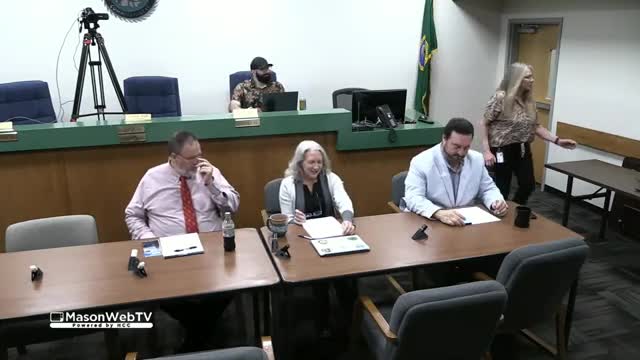
Summary
At a Aug. 20 Belfair sewer work session, Mason County commissioners agreed to place an interlocal agreement (ILA) with the city of Bremerton on a future agenda for further negotiation and possible approval, while several commissioners urged stronger protections, clearer cost allocation and feasibility work before committing capacity.
On Tuesday, Aug. 20, Mason County commissioners at a Belfair sewer work session agreed to place an interlocal agreement (ILA) with the city of Bremerton on an upcoming commission agenda for further negotiation and possible signature, while continuing to debate whether the county should commit sewer capacity or require Bremerton to pay for feasibility and expansion costs first.
The discussion matters because the ILA sets the framework for negotiations over whether Bremerton may use up to 160,000 gallons per day of Mason County sewer capacity, who pays for design and system expansion, and how the counties will allocate costs. Commissioners said a separate state Commerce grant of about $3 million — described in the meeting as split roughly $1.6 million for Bremerton and $1.4 million for Mason County — could fund design and feasibility work but that the grant language and the ILA’s terms must protect Mason County ratepayers.
Commissioner 3, a Mason County commissioner, warned the board that “we're gonna guess on a lot of things because we don't have a feasibility,” and pressed that the county needs a full scope and professional feasibility and design before committing capacity. Commissioner 4, a Mason County commissioner, said Bremerton should pay for metering and any system expansion required to serve new hookups and argued the county should seek to recover value already paid by current ratepayers: “They should be paying for that,” he said of metering and expansion costs. Commissioner 4 also cited expected economic growth tied to the naval shipyard and said Mason County should try to have Bremerton shoulder much of the expansion cost.
Commissioners described two different negotiating priorities. Some commissioners said the county must be able to back out if negotiations or the feasibility study show the project is not in the county’s interest; others said signing an ILA of intent is necessary to get Bremerton and Commerce to proceed with design work and to begin formal negotiations about cost-sharing. As Commissioner 4 put it, signing a statement of intent would start the negotiations that would follow detailed design and cost estimates.
Staff and commissioners noted prior work on the project. The board discussed a financial analysis previously completed by a consultant (FCS), which had been used to frame earlier options: either allowing growth to happen organically or building a trunk line to spur development. Commissioners said that analysis exists but that modern feasibility and design work is still required to determine exact costs, system impacts and what payment or buy‑in the county could require. One cost estimate cited in the meeting for expansion work was roughly $2.25 million; commissioners called that an estimate, not a final figure.
The board discussed rate implications and unit metrics. Commissioners referenced equivalent residential units (ERUs) and said the county’s current break‑even calculations depend on how many ERUs join the system; one exchange noted a rough break‑even ERU figure in the range of about 180 ERUs and that adding more ERUs would lower the per‑unit break‑even charge. Commissioners also discussed whether Bremerton should pay an elevated per‑ERU charge (one commissioner repeatedly suggested 50% above county costs as an illustrative starting point) or a one‑time buy‑in to capture value for existing ratepayers.
On procedural next steps, commissioners instructed staff to prepare a bridging or “cross” document and to place the ILA (or the board’s ILA package and related materials) on the next available agenda for formal consideration. Several commissioners said the county previously approved and sent a letter laying out issues and protections, but they confirmed the ILA itself has not been signed and a signed copy has not been transmitted.
The meeting closed without a final decision to sign the ILA. Commissioners said they remain willing to move forward with negotiations if the county can secure protections that allow it to walk away if feasibility and design work do not support the county’s interests, and if Bremerton contributes to metering, expansion costs or provides an appropriate buy‑in for use of existing capacity. The board instructed staff to get the ILA package ready for a formal vote at an upcoming meeting so negotiations can proceed or stop based on the outcomes of the feasibility and design work.