
CFB ISD trustees receive Team of 8 governance training focused on student outcomes and board roles
Get AI-powered insights, summaries, and transcripts
Subscribe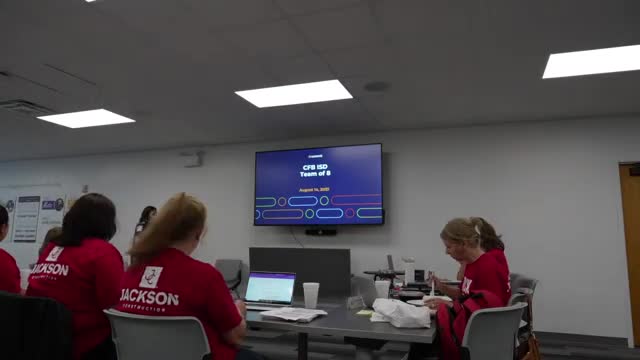
Summary
Trustees of the Carrollton-Farmers Branch ISD spent a work‑study session on Team of 8 governance training from the Commit Partnership, reviewing distinctions between inputs, outputs and student outcomes, SMART goals, and the board's role setting vision, guardrails and monitoring progress.
The Carrollton‑Farmers Branch Independent School District Board of Trustees held a work‑study session in August 2025 for Team of 8 governance training delivered by Tamara Harrington and Joey Rodriguez of the Commit Partnership. President Cassandra Hatfield opened the meeting, saying the trustees present “constitute a quorum and may conduct business on behalf of the district.”
The trainers framed the evening around two core mantras: “student outcomes don't change until adult behaviors change,” and “I am the genesis of transformation.” Tamara Harrington said the training would focus on how boards set student outcome goals, how district leaders translate goals into measurable progress, and how trustees and administrators maintain alignment. Harrington identified the Commit Partnership as a nonprofit and certified provider of Team of 8 governance training.
The session clarified three levels of district work: inputs (teachers, curriculum, facilities, budgets), outputs (benchmarks and interim assessments such as MAP or STAR), and outcomes (end‑of‑cycle measures like third‑grade proficiency, graduation or CCMR). Harrington emphasized the difference between student outcomes —“a measure of what a student knows or is able to do” — and adult or system outcomes (budget decisions, personnel, enrollment targets). Board members discussed examples (pre‑K enrollment, FAFSA completion and teacher retention) and applied the rule: if a measure does not directly represent what students know or can do, it is an adult outcome.
Trainers reviewed high‑quality goal design: SMART, limited in number (3–5), ambitious but attainable over a multiyear horizon, and influenceable (about 80%) by district leadership. Harrington and Rodriguez recommended that boards own the long‑range student outcome goals and set guardrails (values or constraints) while the superintendent owns goal progress measures and operational strategy. Trustees asked practical questions about measures, the district’s existing CV 2030 scorecard, and how progress measures drive resource allocation on campuses.
Trustees and trainers used an extended analogy (an NFL season) to show how inputs and outputs must align if a district hopes to reach a proficiency goal. Harrington advised fewer, clearer goals so administrators can focus resources and the board can track evidence and adjust policy or resources. The training closed with a discussion of monitoring cadence: goal progress measures reported multiple times a year, with the superintendent presenting measurable benchmarks and evidence that strategies are working, and the board using that evidence to approve or redirect resources.
The session was presented as a Team of 8 workshop (no cost to the district, trainers said) and concluded with trustees taking part in a short draft exercise to propose optional additional student outcome goals for the district to consider adopting.