
CFB ISD trustees adopt optional fourth goal to raise fifth‑grade math proficiency
Get AI-powered insights, summaries, and transcripts
Subscribe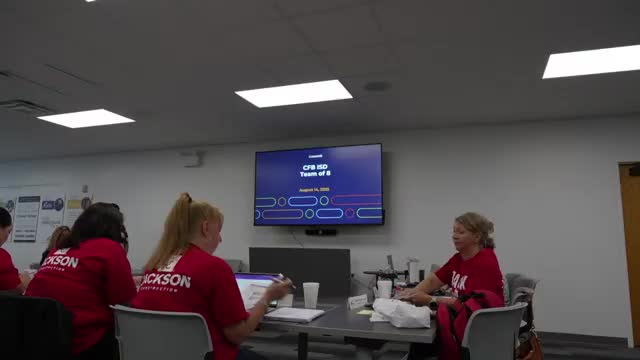
Summary
At an August 2025 board work‑study, Carrollton‑Farmers Branch ISD trustees agreed by consensus to add an optional fourth student‑outcome goal targeting higher fifth‑grade math proficiency; the board directed the superintendent to develop progress measures and return with implementation details in September.
Carrollton‑Farmers Branch Independent School District trustees agreed during a board work‑study in August 2025 to add an optional fourth student‑outcome goal focused on fifth‑grade math proficiency. The board directed Superintendent Eldridge and district staff to develop specific goal‑progress measures and implementation steps and present them at upcoming meetings for board review. Trainers from Commit Partnership led the governance session that framed the decision. The trustees’ new goal calls for increasing the share of fifth‑grade students who reach the district’s proficiency threshold on an end‑of‑year, TEKS‑aligned math assessment by 2030; the precise baseline and target percentages were left blank for staff calculation and will be added when the district confirms the assessment metric. The board’s discussion included whether to target the goal to all fifth‑grade students or to focus on specific subgroups such as emergent bilingual students; trustees ultimately chose language that applies to the full fifth‑grade cohort while noting the superintendent may use subgroup progress measures to direct resources. Commit Partnership trainer Tamara Harrington framed the governance choice by saying, “student outcomes don’t change until adult behaviors change,” and urged the board to set a clear goal that the administration could translate into measurable progress measures. Trustees discussed the instructional rationale for a fifth‑grade math goal (fractions and rational‑number fluency as foundations for algebra readiness) and cited campus‑level variations in performance. Trustee Marjorie Barnes told the group the sample goal language the trainers showed “isn’t very measurable” until staff propose specific metrics and targets. The board agreed that the new goal would be proficiency‑oriented and that the district will use a TEKS‑aligned assessment (STAAR or an alternate TEKS‑aligned end‑of‑year assessment if the district chooses) as the primary outcome measure; staff will indicate which assessment will serve as the official measure when they present the goal‑progress measures. As next steps, trustees directed the superintendent to: (1) produce 1–3 goal progress measures (GPMs) that are predictive and benchmarkable; (2) return to the board with those GPMs for review at the regular board meeting on Sept. 4, 2025 (or the next board workshop), and (3) work with the board to set district guardrails (values and constraints that will guide implementation) at a follow‑up workshop targeted for Sept. 18, 2025. Trainers Joey Rodriguez and Harrington emphasized that the board owns the outcome goals while the superintendent owns the operational outputs and progress monitoring. The trustees also directed subcommittee leads to summarize their work and submit those summaries to staff for incorporation into the GPMs. The board did not set the numeric baseline or target during the work‑study; staff will calculate districtwide and campus baselines and propose annual targets consistent with a 5‑year deadline. Trustees stressed that the chosen goal and its GPMs should be influenceable by district actions (the presenters suggested roughly 80 percent influenceability by the district) and that annual targets should allow the board and administration to monitor whether implemented inputs and adjustments are moving the district toward the 2030 outcome. The work‑study included robust discussion about tradeoffs—trustees were reminded that adding more formal district goals reduces the share of superintendent time and resources that can be devoted to each goal. The session closed with agreement on the fourth goal language (final wording to include staff‑calculated baseline/target) and a schedule for GPMs and guardrail work in September.