
Imperial County registrar outlines shift to Voter’s Choice Act, public hearing set for Sept. 4
Get AI-powered insights, summaries, and transcripts
Subscribe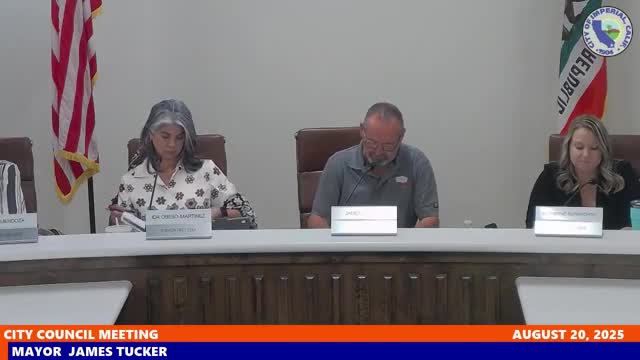
Summary
Lindsey Dale, Imperial County Registrar of Voters, told the City of Imperial council the county will transition from a traditional polling model to the Voter’s Choice Act and has scheduled a Sept. 4 public hearing before submitting its plan to the Secretary of State.
Lindsey Dale, Imperial County Registrar of Voters, told the City of Imperial council the county will transition from a traditional polling‑place model to the Voter’s Choice Act (VCA) system and has drafted an election administration plan and outreach schedule. Dale said the county has secured grant funding to buy equipment and is targeting June 2026 to launch vote centers.
The VCA replaces the precinct‑based model with a system in which every active registered voter receives a vote‑by‑mail ballot, voters may cast ballots at any vote center in the county and vote centers are open for expanded periods (either four days or 11 days depending on the center). "Voters get to choose when, where, and how they vote," Dale said. She added the county has already installed eight secure ballot drop boxes and one in front of Imperial City Hall.
Why it matters: Dale said the VCA model reduces provisional ballots and speeds final results by allowing voters to use any vote center and by enabling election staff to void a mailed ballot on site when a voter casts a replacement. She told the council that Imperial County experienced about 5,500 provisional ballots after the last election — a volume that delayed final tabulation by roughly 2½ weeks — largely because voters went to the wrong polling place or did not surrender their mailed ballot.
Key details from the presentation: - Legal framework and timeline: Dale cited Senate Bill 450 (2016) as the statute creating the Voter’s Choice Act and noted AB 37 (2021) already provides that California active registered voters receive vote‑by‑mail ballots. The county’s proposed plan will be submitted to the California Secretary of State for final approval after local public hearings. Dale said the county has scheduled a public hearing for Sept. 4 at 3 p.m. at the Board of Supervisors chambers. - Vote center placement: State law requires one vote center per 50,000 registered voters for the 11‑day model; Dale said Imperial County’s population of roughly 93,000 registered voters would meet a bare minimum of two 11‑day centers, but the county is proposing three full 11‑day centers (Brawley, Calexico and El Centro) plus eight additional vote‑center locations (11 total) to cover widely spaced communities. - Accessibility and technology: Dale said all vote centers will be in ADA‑compliant facilities near transit and parking. Officials will be able to check registration status in real time on tablets at vote centers, suspend a mailed ballot if a voter chooses to cast in person, and issue ballots on demand. Remote Accessible Vote‑By‑Mail (RAVBM) — a tool that allows voters with compatible technology to mark and print a ballot at home — will be available by request; Dale emphasized this is not internet voting and requires printing and signature verification. - Security and post‑election timing: Dale said the county expects the VCA to sharply reduce but not eliminate provisional ballots, allowing more timely reporting of results. She also warned that, if new legislation triggers a special election (she mentioned pending measures including an ACA referenced as ACA 8 and two bills the registrar named AB 604 and SB 280), counties could face compressed timelines and higher vendor costs; she estimated a countywide special election could cost Imperial County about $680,000 under short notice.
What the council did: The presentation was informational; council members asked clarifying questions about clerk responsibilities and county timelines. No council action was taken. The registrar invited council members and the public to upcoming outreach meetings and the Sept. 4 public hearing before the plan is submitted to the Secretary of State.
For the record: Dale said the county’s draft election administration plan is online in English and Spanish, and that the equipment purchases will be funded by a grant, not the county general fund. She recommended further public outreach and multiple vote centers in larger cities to compensate for low use at some long‑open centers.
Taper: The county is proceeding with consultations, traveling workshops and a required public comment period before final submission to the Secretary of State. The council did not vote on the county plan.