
Warwick County schools hold preliminary hearing on $17 million bond; administration presents 2026 budget plans
Get AI-powered insights, summaries, and transcripts
Subscribe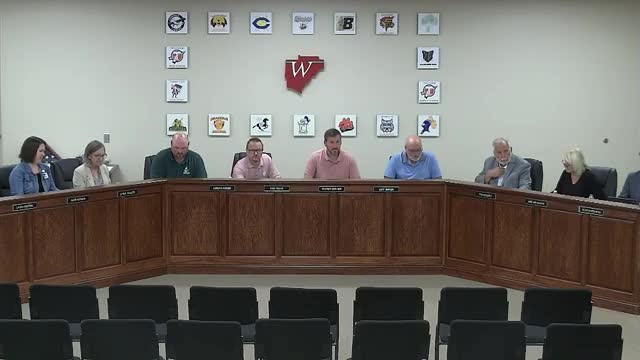
Summary
Assistant superintendent Todd Armstrong presented the proposed 2026 budget, capital projects and a $17 million bond plan intended for building maintenance and renovations; the board held a required preliminary public hearing and took no vote, scheduling a second hearing for Sept. 22.
Todd Armstrong, assistant superintendent for the Warwick County School Corporation, presented the proposed 2026 budget, a three‑year capital projects plan and a five‑year bus replacement plan and opened the district's required preliminary hearing for a proposed $17 million bond issue. "When we issue bonds that exceed the non‑controlled project threshold ... we have to hold two public hearings," Armstrong said, describing required disclosures about maximum borrowing, estimated interest and repayment terms.
The proposed bond would be capped at $17,000,000 with an assumed interest rate of 5.5 percent and an estimated interest cost of $3,285,000 over the loan term; the resolution identifies a maximum maturity date of Jan. 15, 2035 but Armstrong said the administration expects to repay the issue in roughly five years, by late 2030. He said the maximum annual debt service levy language in the resolution would allow up to $5,087,000, and that the maximum possible tax‑rate change for debt service shown in the disclosure is 0.0968 (about 9 cents), but the administration's plan is levy neutral for next year: "Our intent is levy neutral and near rate neutral," Armstrong told the board.
Armstrong reviewed budget line items cited in the public notice: a rainy‑day fund appropriation of $1,100,000; a debt service appropriation of $6,560,000; an education fund appropriation of $88,239,000 (which he said is composed of roughly 92.6 percent salaries and benefits); and an operations fund appropriation that includes capital projects and transportation listed at about $41,000,000. He told the board the advertised bus replacement plan shows roughly $1,054,000 estimated for next year to buy six buses, which Armstrong said reflect current vehicle prices of about $160,000 to $190,000 per bus.
Armstrong also described state revenue changes that affect the budget: a roughly 2 percent statewide increase in tuition support, legislative adjustments that reduced several complexity multipliers (for special education, ELL, CTE and academic honors) and recent homestead‑credit changes; he said those legislative changes complicate the district's assessed‑value forecasting. On circuit breaker credits, Armstrong said the Department of Local Government Finance estimated a $2,360,000 credit but he expects the actual local impact to be lower, possibly under $1 million.
Because the proposed bond would retire two outstanding bonds within two years (2022A for the Pathway Center and a 2024 bond), Armstrong said the district's general obligation capacity is reduced immediately but will recover quickly as the new issues are repaid. He said the administration plans to capitalize a portion of interest to avoid raising the levy in the first year and that some additional appropriation from debt‑service cash balance may be recommended mid‑next year.
The board opened the floor for public comment and none was offered; no board action was taken at the meeting. Dr. Redmond noted this was "the first step in the legal process" and reminded the board that a second required public hearing is scheduled for Sept. 22 at 7 p.m.
Why it matters: the bond would fund maintenance and renovation projects across nearly every building in the district and is structured to avoid increasing the district levy next year unless assessed value drops sharply; however, advertising the maximum borrowing, interest and tax‑rate impacts provides transparency for taxpayers and sets the legal limits for any eventual bond sale.