
County releases proposed 2026 budget with modest tax‑rate cut, funding for salaries and capital projects
Get AI-powered insights, summaries, and transcripts
Subscribe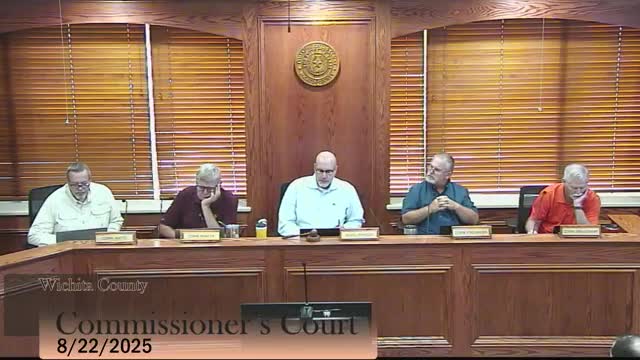
Summary
Shaw County’s proposed 2026 budget totals about $84.68 million, lowers the tax rate slightly, increases compensation in key public-safety classifications and includes transfers to road and bridge, permanent improvements and contingency reserves; commissioners discussed records retention and a potential weigh‑station project.
Shaw County officials presented the proposed 2026 budget to Commissioners Court on Aug. 22, 2025. The budget as presented totals $84,680,000, a decrease of about $1,400,000 (roughly 1.6 percent) from the 2025 adopted budget; county staff said roughly one‑third of expenditures remain in public safety.
County Judge said the budget reduces the county tax rate by a quarter of a cent from last year’s rate but, because of higher property values, would still raise about $1,800,000 more in property tax revenues than last year; staff said roughly $575,000 of expected general‑fund revenue will come from state salary assistance grants for the Sheriff’s Office. The proposed general fund expenditure total is $66,900,000 with expected general fund revenues of about $58,800,000; staff provided scenarios showing fund balance outcomes under different spending assumptions.
The budget proposal allocates compensation increases across most county employees, described as part of a two‑year effort to reach parity with peer counties. Staff said the proposal includes a baseline 3 percent across‑the‑board increase in many departments, with larger targeted increases of about 8 percent for deputy classifications, 6 percent for jailers and 4 percent for administrative staff in the Sheriff’s Office and jail; judicial supplements were increased to follow legislative changes and are partially offset by state reimbursements.
The court reviewed several contingency and transfer lines in the general fund: $750,000 in one‑time spending (chiefly $700,000 for vehicle purchases and $50,000 for furniture), $5,200,000 in emergency spending lines and contingencies (including roughly $3,700,000 in contingency accounts and $1,100,000 for payroll contingency), $500,000 in indigent defense contingency and $1,000,000 in indigent health care contingency. Transfers out include a $1,000,000 transfer to permanent improvements, $1,080,000 to road and bridge allotments (distributed by precinct mileage formula) and $250,000 to the law library to cover publications salary shortfalls.
Commissioners discussed a proposed records retention pilot budgeted at about $115,000 to inventory, classify and remove unnecessary files in justice‑of‑the‑peace and other offices; staff described the pilot as a first step that would inform larger, more costly digitization or storage projects in future budgets.
The court also reviewed a potential way‑station/weigh‑station near U.S. 287 that staff now estimate could cost between $1,000,000 and $1,500,000; staff said the facility could be structured so the county is not the direct enterprise owner but could be built to support enforcement and generate citations that would flow through state processes. County staff noted that permanent improvement fund balances would be materially reduced if the weigh‑station proceeds at the higher cost estimate.
Staff walked commissioners through fund‑balance scenarios showing projected general fund ending balances of about $19,600,000 (roughly 33 percent of annual expenses) under a moderate scenario, $18,460,000 (30 percent) under a worse scenario and $12,400,000 under a catastrophic scenario. The court did not adopt final tax‑rate resolution or budget at the meeting; staff asked commissioners for direction on decision points including the records‑retention pilot and weigh‑station planning.