
Michigan City council approves tax abatements for proposed Phoenix Investors data center amid community concern
Get AI-powered insights, summaries, and transcripts
Subscribe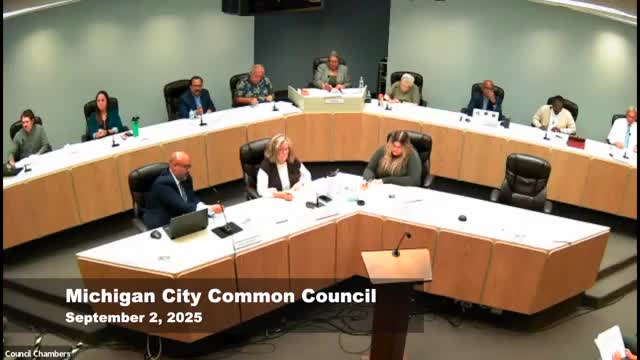
Summary
Michigan City — The Michigan City Common Council voted Sept. 2 to approve a set of tax‑abatement measures and a taxpayer agreement for "Project Maze," a proposed data center at 402 Royal Road, after extended presentations from the developer, utility and municipal staff and a lengthy public comment period.
Michigan City — The Michigan City Common Council voted to approve a set of tax-abatement measures and a related tax agreement on Sept. 2 for a proposed Project Maze data center at 402 Royal Road, after more than two hours of presentation and public comment.
The council approved a vacant-building deduction and a real-property abatement tied to a taxpayer agreement presented by the developer, Phoenix Michigan City Investors LLC, and the project’s attorney, Rick Hall of Barnes & Thornburg. Supporters emphasized immediate and long‑term local revenue, construction jobs and downstream economic activity; opponents raised public‑health, noise, environmental and workforce concerns.
Why it matters: Council members said the abatements and the economic package could bring millions of dollars in upfront and recurring payments to a city facing budget pressures, while residents said the project’s scale and technical features — particularly emergency generators, sound and potential air and water impacts — require fuller safeguards and enforceable commitments.
Phoenix Investors representative John Perret and his team described the plan to renovate the existing 1960s industrial building (the former Federal‑Mogul site) rather than build new structures, and to add electrical and mechanical yards and a customer‑owned substation for redundancy. The developer said the site would host an unnamed U.S.‑based “Global 50” data‑center operator, which the developer and the end user expect to identify publicly after approvals and finalized contracts.
Key technical points the developer presented included: 66 diesel emergency generators on‑site that will be used only as backup power and subject to IDEM and EPA permitting; a stated per‑generator testing and run‑time limit of 31 hours per year (described by the presenter as up to 30 minutes per month, one hour annual maintenance/test, and a 24‑hour allowance for emergencies); a sound study and proposed sound wall and a 6–8‑foot earthen berm with new planting; a closed‑loop air‑cooled chilled‑water system where make‑up water use would be “less than one percent” after the initial fill; and a photometric study for site lighting with shielded, high‑efficiency LED fixtures.
NIPSCO engineer Rick Kalinski told the council NIPSCO has the transmission capacity at that substation site to serve a large load, and said the utility will ring‑fence investments and require that generation‑company costs not be borne by NIPSCO ratepayers; he said any generation procurement to serve the project would be structured so the customer bears the investment.
City water and sanitary officials told council members the municipal water system has capacity for the project as described and that the developer had pledged $100,000 for sanitary‑system improvements downstream from the site; the water superintendent said treatment costs associated with any additional raw water would be charged to the new customer and not spread to existing customers.
Economics and the taxpayer agreement: Attorney Rick Hall said the developer had negotiated a taxpayer agreement that would deliver upfront cash to the city if the project proceeds: $5,500,000 to the city within 90 days of certificate of occupancy, $1,000,000 to the Economic Development Corporation and $100,000 to the sanitary district, and an annual payment of $500,000 to the city for 39 years. Hall described the combined upfront and recurring payments as a multi‑million‑dollar contribution to municipal coffers; he and other presenters said the project also would increase assessed value and property tax receipts after abatements expire.
Council discussion and votes: Council members asked detailed questions about generator testing, monitoring and remediation if sound levels exceed municipal limits; the permanence of the substation and the developer’s responsibility for upgrades; workforce and union participation; and the precise accounting for future tax receipts. Some council members said they wanted additional enforceable commitments on local hiring and monitoring. Notwithstanding the public concerns, the council approved the following measures related to the project: - A vacant‑building deduction (tax abatement) associated with the redevelopment — approved by council majority (vote recorded 7‑2 in final passage). - A real‑property assessed‑valuation deduction (40‑year ERA qualification with the 10‑year limitation under state law) — approved by majority vote. - A city resolution confirming the Economic Revitalization Area (ERA) designation — approved. - A tax‑abatement/taxpayer agreement labeled "Project Maze" that memorialized the upfront payments and the annual payments — approved.
Public comment: The council heard roughly an hour of public testimony, including dozens of callers and speakers in the chambers. Supporters included local contractors and union signatories who said the project would create hundreds of construction jobs and dozens of permanent technical positions, plus local purchasing for hotels, restaurants and suppliers. Opponents and residents living near the site urged the council to delay approvals until independent health and noise studies, enforceable community benefits agreements and stronger local‑hiring guarantees were in place. Several speakers asked the council to reconsider the size and length of abatements and to preserve local oversight of generator testing and air‑emissions permitting.
What the council decided and what’s next: By approving the abatements and the taxpayer agreement, the council has granted the developer the economic incentives requested. Council members who voted in favor said the package helps the city’s fiscal position and will spur further private investment; those who voted against said the council should have required more binding community protections and stronger, immediately enforceable local‑workforce commitments.
Permits and enforcement: The council’s votes do not replace the building, air, water or electrical permits the project must obtain. The developer said it will submit required permit applications and site plans to city departments and state agencies, and that IDEM and EPA air permits would be required for the standby generators. Several council members and residents said they intend to press staff for enforceable noise monitoring, public reporting of generator testing, and clear, contractually binding local‑hiring requirements before or as the project proceeds.
Ending: Council members said the project illustrated the tradeoffs city leaders face between near‑term fiscal relief and the long‑term environmental, health and community costs that neighbors fear. The developer and utility said the technical work and permit reviews remain to be completed; residents and some council members said they will continue to push for stronger, enforceable protections in the weeks ahead.