
Michigan City leaders push wheel and excise tax to offset looming state cuts
Get AI-powered insights, summaries, and transcripts
Subscribe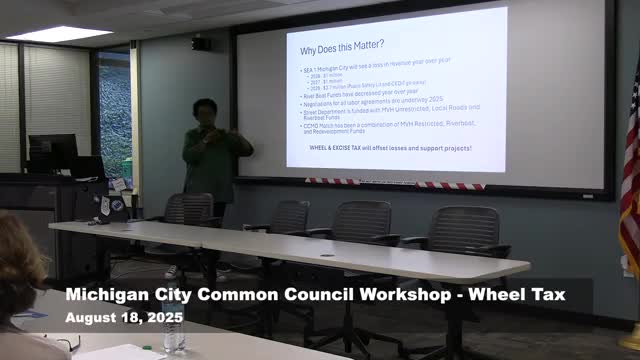
Summary
At an Aug. 18 Michigan City Common Council workshop, city officials outlined steep projected revenue losses from recent state legislation and recommended adopting a combined wheel-and-excise ordinance by Sept. 1 to unlock new state road distributions and reduce pressure on declining riverboat and other local funds.
Michigan City Mayor Angie told a workshop audience Aug. 18 that the city must act quickly to adopt a combined wheel-and-excise tax ordinance so it can qualify for new state road distributions and blunt planned state tax changes that will shrink local revenues. "For us to start getting that distribution next year, it has to be done before September 1," Mayor Angie said.
The mayor and outside consultants described how recent state measures — identified in the workshop as Senate Enrolled Act 1 and House Enrolled Act 1461 — will reduce local property-tax receipts and shift revenue responsibilities to cities. Matt Growler, chief executive officer of AIM, told the council, "No one likes passing a tax," but urged local officials to prepare for the changes by adopting new local revenue tools and said, "You're going to have to pass new fees probably on down the road."
Why it matters: city officials said riverboat revenues and other one-time federal funds that helped balance past budgets are declining or exhausted, leaving gaps in street maintenance, matching grants and public-safety support. The administration estimated a roughly $1 million annual shortfall in 2026 and 2027 and a projected $3.7 million shortfall in 2028 tied to the statewide changes. Mayor Angie said the city currently relies on about $8 million a year in riverboat funding, and that transfers of roughly $1.6–$1.9 million from riverboat funds have been covering the street department's operations.
At the workshop the mayor presented details of the local proposal and clarifications about how the two parts of the proposed ordinance would work together. The administration described the ordinance as a single measure that contains both an excise tax on passenger vehicles and a wheel tax for commercial vehicles; it said the two components must be passed together. Under the city's illustrative calculator shared with council members, the minimum estimated revenue from a locally adopted schedule would be about $183,000 per year; the council was told many cities pursue the maximum rates. City staff said sample fees discussed included $25 for passenger vehicles, $40 for commercial vehicles and $15 for motorcycles in the city's modeling.
Officials said adopting the ordinance would also make the city eligible for a new "lane-mile direct distribution" created by House Enrolled Act 1461. The administration estimated Michigan City has 244 lane miles and would receive roughly $200,000 a year under current draft formulas, beginning with a distribution planned for June 2027 if the local ordinance is adopted in time.
Council members and residents pressed for clarifications. A councilor asked whether residents would pay both a county wheel tax and a city wheel tax; staff said the county had not adopted a countywide wheel tax and that the BMV (Bureau of Motor Vehicles) collects the fee at plate renewal and forwards distributions to the state, which then remits funds to municipalities that qualify. Resident Ray Maloney opposed new local taxes, saying he had lived under a wheel tax in Cook County and was "dead set against any wheel tax and any additional tax." The mayor and AIM representatives responded that the city faces structural revenue shifts and declining riverboat and ARPA (American Rescue Plan Act) funds and that failing to act would force deeper cuts to services or reliance on dwindling reserves.
The workshop also covered program-level consequences: city staff said the public-safety levy that currently provides about $4 million a year (roughly $2 million each for police and fire) is vulnerable under the state changes; officials warned that moving to the new state income-tax structure will not replace the revenue being lost. Staff also explained that qualifying for some state matching grants (referred to in the workshop as CCMG) is not currently conditioned on adopting a wheel tax, but that receiving the lane-mile direct distribution would reduce the city's required local match for certain grants because it provides an automatic annual revenue stream.
Staff described additional options under consideration, including creating an in-house paving capability. The mayor said staff priced equipment for an internal paving program at about $2,000,000, which city leaders said they are weighing as a way to control rising external contract costs. Officials cautioned the council that several implementation details remain unresolved at the state level and that statutory guidance and distribution formulas are still being developed.
Next steps and timing: the administration said it will present the ordinance for consideration at the regular council meeting with second and third reading scheduled the following day. Staff emphasized administrative deadlines: to be eligible for next-year distributions the city must adopt the ordinance and submit required paperwork to the Bureau of Motor Vehicles and the Indiana Department of Revenue before Sept. 1; if adopted in time the ordinance would become effective Jan. 1. The administration also agreed to provide the council with the presentation slides and the city's revenue calculator ahead of Monday's meeting.