
Michigan City mayor outlines wheel, excise tax plan to shore up road funding as state law changes take effect
Get AI-powered insights, summaries, and transcripts
Subscribe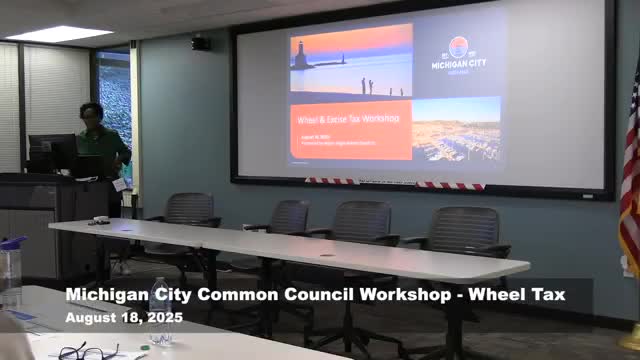
Summary
Mayor Angie told a Michigan City Common Council workshop on Aug. 18 that the city will bring a combined wheel and excise tax ordinance back for second and third readings the next day and urged the council to act before Sept. 1 so the city can qualify for new state road funding created by recent legislation.
Mayor Angie told a Michigan City Common Council workshop on Aug. 18 that the city will bring a combined wheel and excise tax ordinance back for second and third readings the next day and urged the council to act before Sept. 1 so the city can qualify for new state road funding created by recent legislation. “I know that we have second reading tomorrow on, the wheel tax,” the mayor said, adding the rule changes make the measure time‑sensitive.
The discussion centered on two recent laws the city said will reduce some local revenues while creating a new lane‑mile direct distribution that is available only to municipalities that adopt a local wheel tax. City officials described the changes as follows: Senate Enrolled Act 1 will produce multi‑year reductions in property‑tax–based revenue beginning in 2026 and grow to a projected $3.7 million shortfall for Michigan City in 2028; House Enrolled Act 1461 creates a lane‑mile direct distribution tied to the number of lane miles in a jurisdiction and requires adoption of a local wheel tax to receive those funds.
Why it matters: city officials said Michigan City has relied heavily on riverboat revenue and one‑time federal funds and is now facing structural shortfalls and declining reserves. The mayor described the city’s riverboat receipts at a historic high of about $26 million in 2014 and a COVID low near $6.8 million, with a recent average of roughly $8 million. “We have been living off of riverboat money,” the mayor said, and warned that cash reserves were largely spent down in prior years.
City staff and outside consultants from AIM (consulting) told the council the new state rules shift responsibility to local governments and create both risk and an opportunity. “If you don’t have a city wheel tax in place, you’re gonna be missing out on some automatic money that would be coming your way,” Matt Growler, CEO of AIM, said. He and AIM’s Jennifer Simmons, COO, urged council members to consider the new revenue options in light of expected statewide changes to local tax bases and future income‑tax options.
Officials explained program interactions in practical terms: adopting the local wheel tax (a flat fee charged at vehicle registration) and an excise tax on passenger vehicles would unlock the lane‑mile direct distribution starting in mid‑2027, but those local levies also alter eligibility or matching calculations for Community Crossings Matching Grants (CCMG). The mayor used an example to illustrate the interaction: if a CCMG project had a $1 million cap and the city received a $200,000 lane‑mile distribution, the maximum CCMG award would effectively drop to $800,000 because the new state distribution reduces the grant cap and therefore the match required.
Officials gave cost and revenue estimates the council can use when choosing rates. The presentation showed a range of choices: a $5 minimum wheel tax up to a $40 maximum for commercial vehicles, and an excise tax with a $7.50 minimum up to $25 for passenger vehicles; the city’s “maximum” scenario used $25 for passenger cars and $40 for commercial registrations. For Michigan City specifically, staff estimated a minimum combined option would produce roughly $183,000 annually while the maximum scenario would yield substantially more (estimates distributed to councilmembers show larger amounts). The mayor said Michigan City’s inventory of about 244 lane miles would generate roughly $200,000‑plus per year under the lane‑mile distribution if the city adopts the wheel tax.
City finance staff framed the decision against other fiscal pressures: the mayor said the city is negotiating multiple labor contracts this year, medical insurance costs are rising, and American Rescue Plan (ARPA) funds and other one‑time receipts that helped in recent years are exhausted. She said the city used roughly $1.6 million to $1.9 million annually in riverboat transfers to support the street department and that CCMG matching has been cobbled together from declining sources such as TIF and riverboat funds. She also noted that the city is considering an internal paving program that would require about $2 million in equipment to reduce outsourced bidding costs.
Council process and timeline: the mayor said the ordinance combining wheel and excise taxes must be adopted before Sept. 1 for the city to submit the levy to the Indiana Bureau of Motor Vehicles and the Department of Revenue; if adopted, the local fee would take effect Jan. 1 of the following year and the first lane‑mile distribution would arrive in June 2027. The mayor said the council is scheduled to take the ordinance up for second and third readings the night after the workshop; no formal vote occurred at the workshop.
Points of disagreement and public comment: residents raised objections to new fees during the workshop. Ray Maloney, a Michigan City resident, said he opposed additional taxes and urged a minimal levy if the council proceeds: “I am dead set against any wheel tax and any additional tax … If you do have to implement this, let’s make it a $5 tax.” The mayor and AIM consultants responded to questions about county‑level levies and collections: the fee is paid at vehicle registration through the BMV and remitted by the state, and county or city wheel taxes may both exist in different jurisdictions.
Unresolved details: city staff and the consultants said several administrative and allocation details remain uncertain because state agencies are still working through implementation guidance for HEA 1461 and related rules. The mayor said staff will present a concise set of slides and numerical impacts at the formal council meeting so the public can compare options before any vote.
Direction vs. formal action: the workshop produced direction to finalize ordinance language, run the council’s revenue calculator with chosen rates and revenue scenarios, and prepare required submissions to state agencies if the council adopts the ordinance. There was no formal vote or final action at the workshop.
What’s next: the council is scheduled to consider second and third readings of a combined wheel/excise tax ordinance at its regular meeting, with staff to provide supplemental slides documenting riverboat trends, CCMG interactions and the estimated fiscal impact of Senate Enrolled Act 1 and House Enrolled Act 1461.