
Michigan City approves tax abatements for Phoenix Investors data center amid sustained public opposition
Get AI-powered insights, summaries, and transcripts
Subscribe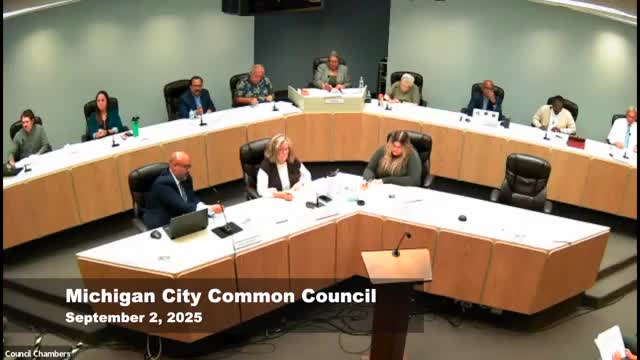
Summary
The Michigan City Common Council approved several tax-abatement resolutions for Phoenix Investors' proposed data center at 402 Royal Road after extended presentations, questions from city staff and utilities, and more than an hour of public comment that included both pro-union voices and residents warning of health and noise impacts.
Michigan City Common Council members voted this week to approve several tax-abatement measures tied to Project Maze, a proposed data center at 402 Royal Road, where Phoenix Investors plans to renovate the former Federal-Mogul plant into a multistage data facility. The council approved a real-property abatement, an economic-revitalization-area confirmation and a tax-abatement agreement; one initial effort to table consideration failed.
The project team and utility partners told the council the site is suited to a data center because it is adjacent to existing utility infrastructure and an existing substation. John Perret of Phoenix Investors told the council, “I know there's a lot of misinformation out there about this project and a lot of skepticism about who the end user is. What I can state at this moment about the end user is it's not Elon Musk.” Rick Kalinski, director of economic development and public affairs for NIPSCO, told the council the utility will use a model that keeps the cost of generation and transmission for this large customer separate from NIPSCO’s rate base: “We will not compromise our reliability or affordability,” he said.
Why it matters: the city will receive upfront and recurring cash payments tied to the developer's agreement and the assessed value of the redeveloped property, while neighbors and community groups pressed council members on noise, generator testing, water use and local hiring. Council supporters cited new tax revenue, construction jobs and long-term local economic development; opponents cited potential noise and health effects, generator testing and the scale of state and federal incentives.
Project details and mitigation plans: Phoenix Investors proposes to adaptively reuse the existing 400,000-square-foot structure on the former Federal-Mogul site. The developer said the site will use two new NIPSCO feeds into a customer-owned substation for redundancy; the mechanical yard and electrical yard would be placed east and north of the building. Phoenix told the council it plans a six- to eight-foot earth berm and a landscape buffer along Royal Road, with an initial plan for 150–175 trees and 140–160 shrubs; a sound wall around the mechanical/chiller yard is under design. The project team stated that the plant will rely on a closed-loop air-cooled chilled-water system that needs only a small annual makeup water amount after initial fill.
Generators, testing and emissions: The developer said the facility would host 66 diesel emergency backup generators for outages only, not permanent on-site generation. Per the presentation, IDEM and EPA air permits will limit individual generator runtime to about 31 hours per year; Phoenix described that total as including routine monthly runtime (up to 30 minutes per month), one hour per year for annual testing and up to 24 hours in a declared emergency, after which the generator must be shut down for the rest of that year. The project team estimated phase-one CO2 emissions of roughly 416 tons per year (project team presentation).
Economics and incentives: The developer and its counsel described a package of upfront and recurring payments. Phoenix counsel Rick Hall said the company agreed to provide $5.5 million to the city within 90 days of certificate of occupancy, $1 million to the Economic Development Corporation and $100,000 for sewer improvements. Hall and city financial staff also described recurring payments of $500,000 per year for up to 39 years; the presentation’s cumulative cash figure for the city and partners ranged in the meeting transcript as those numbers were discussed and clarified in real time by the city financial adviser. Financial adviser Dan Bodich later was quoted in the meeting as estimating tax savings and projections related to abatements; the council’s final vote authorized a deduction of assessed value for qualified improvements up to the cost caps in the approved agreement.
Utilities and infrastructure commitments: NIPSCO said it has capacity at an existing substation to serve a project like this but will require separate generation and transmission investment that would be ring-fenced to the project so that other ratepayers do not shoulder the cost. NIPSCO reiterated it would not move forward unless contractual protections were in place. The Department of Water Works told the council the municipal system has capacity to support the initial fill and ongoing needs of a closed-loop chilled-water system and that incremental treatment chemicals would be charged to the new customer, not spread across existing ratepayers. The developer said it would pay for necessary utility upgrades; the project also commits $100,000 to sanitary improvements downstream of the site.
Labor and local hiring: Phoenix stated that several local unions have engaged in early work, and project representatives said they had identified eight local unions as currently doing some site work or committed to the project. Union leaders and local building trades representatives asked the council to condition incentives on local-hire or community workforce agreements; several union leaders said they had not received binding commitments on union labor from the end user and urged the council to insist on stronger local hiring guarantees.
Council action and votes: After presentations, questions and an extended public comment period, the council approved multiple related measures. Motions to table some items failed. Recorded votes on the measures affecting the project showed a series of approvals: the assessed-value deduction for real property and the ERA confirmation passed (votes recorded in the official minutes), and the council approved an accompanying tax-abatement agreement with recorded tallies. (The meeting transcript and the formal signed resolutions in the municipal record contain the precise vote tallies and the official text of the agreement.)
Public comment and concerns: More than an hour of public comment produced a mix of positions. Proponents emphasized jobs, construction activity and downstream spending at local restaurants, hotels and suppliers. Opponents raised noise and health concerns (including questions about low-frequency sound), potential generator testing frequency, water and wastewater effects, and the scale and duration of tax incentives. Several public speakers asked the council to delay action to seek additional independent studies or stricter local conditions. Others, including business owners and union representatives, urged the council to approve the project to capture immediate economic activity and long-term assessed-value gains.
Next steps: The project will require state and federal permits (IDEM/EPA air permits for engines, other building and life-safety permits) and further development-level site plans and sound studies submitted with permit applications. Council members and staff referenced ongoing negotiations and rulemaking work on local ordinances related to sound and other data-center–specific measures. The council’s votes at this meeting authorized the local components contained in the resolutions; permitting and enforcement of operating conditions will proceed through the applicable municipal, state and federal processes.
Ending: The council’s votes set the regulatory and fiscal framework for the developer’s next steps and for permit review, while many residents and union leaders said they will continue to press the city for stronger local-hire commitments and enforceable community protections.