
Michigan City council adopts vehicle excise surtax and wheel tax to bolster road funding
Get AI-powered insights, summaries, and transcripts
Subscribe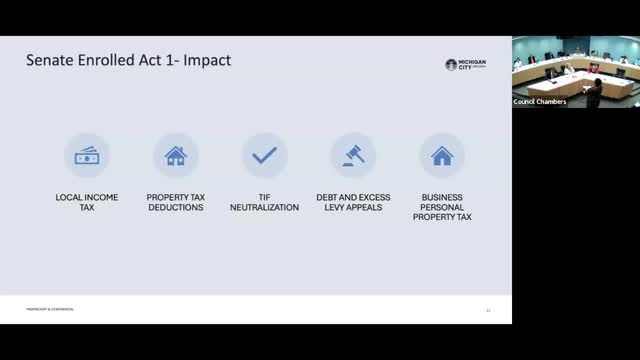
Summary
The Michigan City Common Council voted 9-0 on Aug. 19 to adopt a municipal motor vehicle license excise surtax and municipal wheel tax as part of a broader plan to reduce reliance on riverboat funds and shore up street-maintenance budgets.
Michigan City’s Common Council voted 9-0 on Aug. 19 to adopt an ordinance creating a municipal motor vehicle license excise surtax and a municipal wheel tax, a move the mayor and several council members said is intended to replace declining riverboat revenue and stabilize funding for streets and capital equipment.
Mayor Angie framed the vote as a response to falling riverboat receipts and recent state legislative changes. “We’re gonna be under $8,000,000 in riverboat funds for this year,” she said during the council meeting, noting that riverboat revenues that once reached $26 million in a single year have declined and that the city has relied on one-time federal funds in recent years. The mayor described the surtax structure presented to the council, noting passenger-vehicle excise surtax options up to $25 per year and commercial wheel tax options up to $40; she added, “The $25 a year is about 7¢ a day.”
Why it matters: City officials said the new local fees will reduce pressure on riverboat funds that have been used to support the street department and to match state Community Crossings (CCMG) grants. The mayor told the council that the city budget included $1.6 million (2025) to $1.9 million (2024) in riverboat funds supporting street work and that continued declines require new, stable revenue. Passing both the excise and wheel taxes also makes the city eligible for a new lane-mile direct distribution in 2027; the mayor estimated Michigan City’s share of that lane-mile distribution at about $200,000 annually once it begins.
What the council did: Councilman Bryant Dabney moved to suspend rules to allow second and third readings the same evening; the council approved the suspension 9-0 and then approved the ordinance on third reading by voice vote (recorded roll call: 9 in favor, 0 opposed). Dabney made the final motion to approve the ordinance; Dr. Amir Cora seconded it.
Discussion highlights and public comment: Council members debated rate levels and timing. Councilman Paul Przybylinski said he supported adopting the maximum rates presented so the city could capture the larger revenue estimate; other council members and several members of the public urged consideration of the ordinance’s impact on low-income and fixed-income residents. Public commenters included Scott Mellon, who urged passage at the higher level to reduce pressure on other funds, and Ernie Allahan, who said he would accept the increase to avoid deeper cuts later. The mayor and staff reiterated that the lane-mile distribution tied to passing both taxes does not begin until 2027 and that the ordinance merely implements the local taxing mechanism allowed by recent state legislation.
Limits and next steps: The ordinance passed as presented by the administration and will be implemented through the state’s motor-vehicle licensing process; the mayor and staff said state administrative details and lane-mile distribution calculations will be finalized by state agencies. Officials said the city may use proceeds to fund equipment to perform paving in-house and to reduce reliance on riverboat transfers for the street department. Council members and the mayor said they expect continued budget conversations as other state changes phase in through 2028.
Ending: With the 9-0 vote, Michigan City established local vehicle-based taxes intended to create a predictable revenue stream for roads and to reduce reliance on riverboat and one-time federal funds; implementation details and exact use of the proceeds will be discussed in upcoming budget hearings and follow-up staff briefings.