
Residents press council for transparency and health studies on proposed data center near Trail Creek
Get AI-powered insights, summaries, and transcripts
Subscribe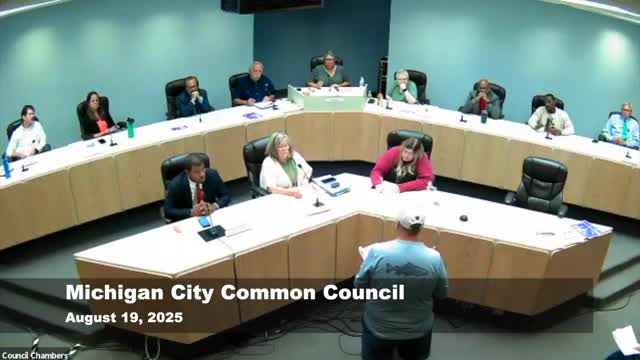
Summary
Multiple residents used public comment to press the council for clearer information about a proposed data center — asking whether it will be a cloud, AI or cryptocurrency facility, and seeking details on noise, cooling, power, water use and the project's end user — and cited health and environmental concerns.
A variety of residents urged the Michigan City Common Council on Aug. 19 to demand more transparency and technical studies about a proposed data-center project near Trail Creek, raising questions about end users, noise, water use, power consumption and the terms of non-disclosure agreements.
“Is it a cloud center? Is it an AI center? Is it a Bitcoin mining center?” asked Matthew Marchand, a resident who said his home sits about two-thirds of a mile from the site. He asked council members for specifics about noise mitigation (acoustic treatments), cooling systems (air vs. liquid) and estimated construction duration.
Other speakers added technical and health concerns. Tom Haddock, who said he came from a region with many data centers, told the council medium-sized data centers of the type discussed can use “1 to 5 megawatts” of electrical capacity — roughly the equivalent of power for a thousand to several thousand homes — and cited examples of high daily water use for cooling.
John Carrington disputed developer noise comparisons and said the often-cited “65 decibels” benchmark is louder than household appliances. “65 decibels is more like a busy restaurant,” Carrington said, and he urged independent acoustic evaluation.
Amy Listenski, a resident active in the review process, asked for a second public workshop with additional technical experts and for clarity on an apparent discrepancy: developers presenting at a community meeting described the project as speculative with no confirmed end user, yet meeting materials discussed end-user preferences and noise exemptions. She and others asked whether the city had required an independent environmental or public-health study.
Multiple members of the public also referenced correspondence received by the clerk: letters from Kathleen Early and Eileen Mark and a petition referenced by Tom Mazymek opposing a proposed rehabilitation facility (the clerk’s communications list included data-center correspondence on Aug. 15 and Aug. 1). State Representative Pat Boy’s inquiries about the project were also noted in the clerk’s packet.
City officials present did not adopt new rules or studies at the meeting. Redevelopment staff and counsel have said in recent meetings that project specifics, including end-user identity, affect mitigation measures and contractual terms; the council took no formal action on the data-center project at this meeting.
Ending: Residents asked the council to secure independent acoustic, environmental and water-use studies and to require clearer disclosure of the project’s end user and mitigation commitments before any final approvals; council members present acknowledged receipt of the concerns and said the project will proceed through regular planning and redevelopment steps.