
Council expands riverboat alcohol-license district, establishes $2,500-per-license fund
Get AI-powered insights, summaries, and transcripts
Subscribe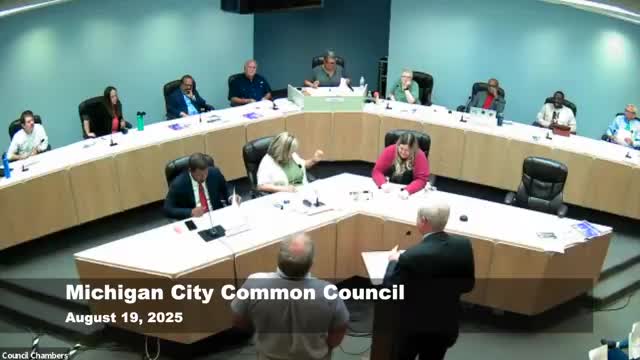
Summary
The council approved a Redevelopment Commission resolution to expand the riverboat-related downtown alcohol-license area to match changes in state law and to implement a $2,500 annual fee for each license to seed a new downtown fund, the Redevelopment Commission and attorney said.
The Michigan City Common Council on Aug. 19 voted 9-0 to approve a Redevelopment Commission resolution that expands the city’s riverboat-related alcohol-license boundary and implements an annual $2,500 license fee to create a downtown fund.
Alan Sarenak, attorney for the Redevelopment Commission, said the 2008 state law that created the riverboat/downtown alcohol-license program was later changed in 2019 to expand the eligible area to within 3,000 feet of the riverfront median. Sarenak said some parcels in Michigan City fell within the 3,000-foot statutory band but were not in the original local district map.
“The Commission is recommending to the Council that in addition to expanding the districts, that the Council also approve this riverfront district fund and at the cost for anybody who receives a license at $2,500 a year,” Sarenak said during the presentation.
Under the approved resolution, the redevelopment area map will be formally modified to include the expanded parcels, and the Redevelopment Commission will collect the $2,500 annual administrative fee from license holders and deposit the receipts into a fund to be created by council ordinance. Sarenak said the council will control how the fund is spent and the commission would administer collection and enforcement.
Public comment included questions about the map extent and how the fund might be used. Scott Mellon, a resident who has followed downtown redevelopment, described the measure as “a tool” to promote downtown dining and said a parcel-by-parcel online map will clarify eligibility.
Action details: Councilwoman Tillman introduced the resolution; Councilman Prince Belinski moved for approval with a second by Councilman Beartree. The clerk recorded a 9-0 vote in favor.
Why it matters: the fund is intended to support downtown dining and activation — examples mentioned by the redevelopment attorney and council members included marketing, events and DORA (designated outdoor refreshment area) support. Officials said the revenue stream will be modest initially — the commission estimated roughly $25,000 annually based on current license holders — and the council must later adopt an ordinance to establish the fund officially and set spending rules.
Discussion vs. decision: the council approved the resolution to expand the eligible area and authorize the fee; the council did not adopt the fund ordinance that will establish spending rules, which requires a separate ordinance.
Ending: Redevelopment and planning staff said they will publish a parcel map online and return with an ordinance to establish the fund and spending procedures.