
Ashland to host EPA service-line survey in September as part of "Get the Lead Out" initiative
Get AI-powered insights, summaries, and transcripts
Subscribe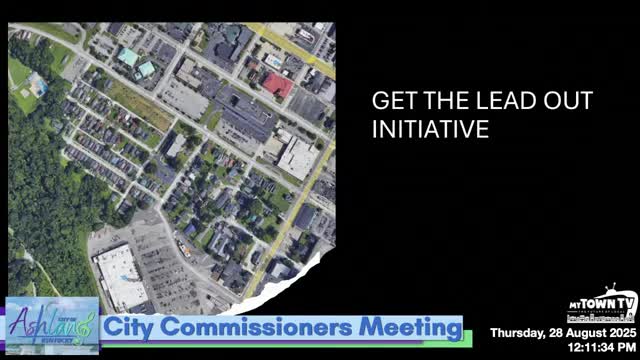
Summary
City engineering staff said contractors working under the U.S. EPA initiative will canvass a portion of south Ashland in September to identify water-service line materials; staff said identifying each service line can save about $700 per home and that lead is unlikely but guidance will be provided if found.
City of Ashland engineering staff told the Board of City Commissioners on Aug. 28 that contractors working under the U.S. Environmental Protection Agency's service-line identification effort will begin door-to-door surveys in a portion of south Ashland in September.
"To get the lead out initiative is a requirement of every water system in the United States to identify service line material," Engineering Director Barry Atkins said. Contractors contracted through the EPA will conduct on-site identification in the area south of Central Avenue between Sixth Street and Twelfth Street. Yard cards notifying residents have been placed in advance, and residents can self-identify their service line type through a customer survey linked by QR code or on the city website.
Atkins said the city can accompany the contractor if a resident prefers, and each service line identified by this method yields an estimated cost savings of about $700 per home. He also advised residents not to be alarmed: "It's highly unlikely that any service line will be identified as lead. In the event that lead is discovered, customers can contact the utility office at (606) 385-3200 for guidance," Atkins said.
The engineering department said the majority of yard cards had been placed as of roughly an hour before the meeting. The effort is presented as part of federal compliance and local cost-saving measures; identifying service-line materials helps the city target replacement or remediation programs and may affect future project funding.
No vote was required; commissioners asked staff for details and encouraged public outreach to ensure residents understand the purpose and steps of the survey.