
Walker County adopts $2025-26 budget and raises property tax rate to 0.4571 per $100
Get AI-powered insights, summaries, and transcripts
Subscribe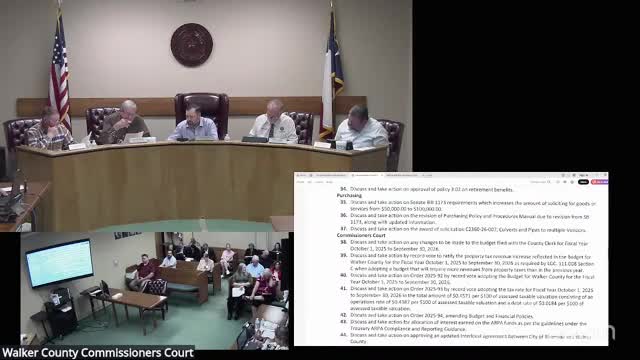
Summary
The Walker County Commissioners Court adopted the fiscal 2025–26 budget and approved a property tax rate of 0.4571 per $100 of assessed taxable value, which the court said is effectively a 4.6% increase from the prior year.
Walker County commissioners adopted the county’s fiscal 2025–26 budget and approved a property tax rate of 0.4571 per $100 of assessed taxable value at their Aug. 25 meeting.
The court approved Order 2025-92 adopting the budget for the fiscal year beginning Oct. 1, 2025, and then adopted Order 2025-93 setting the tax rate at 0.4571 per $100 — an operations rate of 0.4387 and a debt rate of 0.0184 per $100. County officials said the rate is effectively a 4.6% increase from the previous year.
The action followed a public hearing on the county budget and a separate public hearing on the proposed tax rate earlier in the meeting. The court also took a record vote to ratify the property tax revenue increase as required by Local Government Code 111.008(c).
According to the clerk’s reading, the tax rate motion and the budget ordinance each passed on recorded motions and roll-call-style affirmation by court members. The court’s discussion included a request for precise wording of the tax-order language and a clarification readback on the operations rate before the vote.
The budget adoption and tax-rate decisions are the culmination of the county’s annual budget process; the adopted budget covers operations and the county’s debt obligations for the year starting Oct. 1, 2025. Court members and staff did not at the meeting provide a line-item spending summary or an immediate breakdown of which departments will absorb the largest changes.
The court’s formal actions on the budget and tax rate were taken by motion, second and an affirmative vote (the clerk announced the motion carried). Procedural references during the meeting cited Local Government Code 111.008 in connection with notifying the public about a property tax revenue increase.
County residents seeking the full budget document and vote record were directed to the county clerk’s office and the commissioner court’s office for the adopted ordinance and the record vote.
For context, the court must hold public hearings and adopt a budget before the start of the fiscal year; state law requires certain notices and a record vote when the budget requires more property-tax revenue than the prior year.