
Commissioners escrow $300,000 for courthouse dome, $100,000 for train depot; staff authorized to pursue piggyback roofing contract
Get AI-powered insights, summaries, and transcripts
Subscribe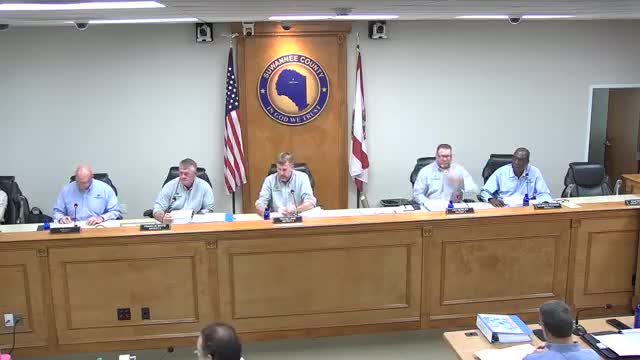
Summary
After extended discussion of historic-preservation requirements and funding options, commissioners directed staff to escrow $300,000 for the courthouse dome and $100,000 for the train depot roof and to pursue a piggyback contract to expedite repairs; FEMA and state historic grants were discussed as possible but uncertain funding sources.
County staff outlined repair estimates and historic-preservation constraints for the Suwannee County Courthouse dome and the nearby historic train depot, and the board reached consensus to set aside funds and move forward with procurement options. The county staff member who presented the repair options said, "They generally require plan approval and via architects with historic preservation credentials. We have to update the the, National Historic Registry when we use these. The miss there are material restrictions when we use that, so we have to use material specific for the historic to remain that historic, integrity." He recommended using an existing piggybackable contract the county had used previously to speed the work.
Staff estimated the dome repairs at about $321,000 and the train depot roof at roughly $100,000. The presenter warned that state historic-preservation grants are highly competitive, require plan approval, and are typically paid after the county completes and pays for work up front. He said pursuing those grants could extend project timelines by two to three years and increase costs, while contracting through an existing piggyback agreement could expedite completion and reduce the immediate procurement burden.
The board reached verbal consensus to escrow $300,000 for the courthouse dome and $100,000 for the depot roof and to allow staff to pursue the piggyback contract to expedite work; that direction was recorded as consensus rather than a roll-call vote. Commissioners and staff discussed materials and aesthetics; staff noted that because the courthouse is on the historic registry, materials and finishes may need to match historically accurate profiles and that some previously made changes to the building might have to be addressed under compliance rules.
The presenter said FEMA reimbursement is a possibility for the dome and depot projects because they originated from a declared event, but he emphasized there is no guarantee and that the county would need to pay costs up front in most grant scenarios.
Next steps: staff was directed to proceed with procurement under the piggyback contract if feasible, to bring back specific bids or contract documents, and to report any grant-application opportunities and estimated net costs before the final budget action.