
Santaquin officials briefed on plan to convert Strawberry water for municipal use
Get AI-powered insights, summaries, and transcripts
Subscribe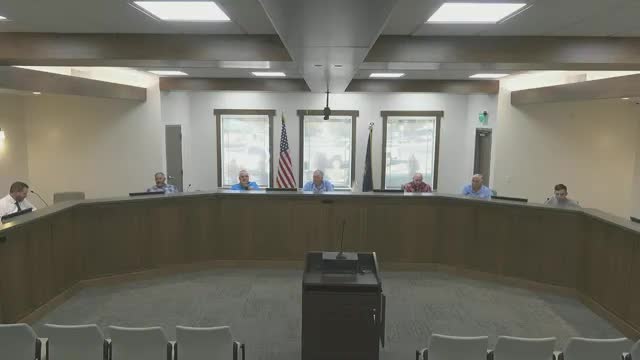
Summary
City staff and consultant Chris Thompson described a near-final agreement under the 1920 Miscellaneous Purpose Act that would allow Strawberry Valley Project water to be converted from agricultural to municipal and industrial (M&I) use and outlined next steps, including a council resolution and third-party agreements.
Santaquin City Council members heard detailed briefings Tuesday on a pending change that would let the city accept Strawberry Valley Project water for municipal and industrial (M&I) use. City staff and consultant Chris Thompson said a near-final agreement under the 1920 Miscellaneous Purpose Act would allow Strawberry water to be detached from the land where it is currently appurtenant and converted for use in city systems.
The matter matters because Strawberry water is high-quality, pressurized water delivered from Strawberry Reservoir and—if converted—could be delivered through the ULS pipeline to Santaquin for irrigation and eventually potable supply once a regional treatment plant is built. "It no longer has to be appurtenant to the land," Chris Thompson, consultant with Hansen Allen & Luce, said of the conversion the agreement would allow.
The nut of the discussion was process and timing. Thompson said the larger group of initial signatories will sign the 1920-act agreement on Sept. 18; Santaquin is not among the original signatories but can become a beneficiary once it adopts a local resolution and executes required third-party conversion agreements. A city staff member said staff will present a template resolution for council consideration and plan to place it on the council agenda for Sept. 16.
Council members and staff discussed how converted water would enter the city system and how it differs from existing Central Utah Project (CUP) and ULS water allocations. Thompson and city staff said Santaquin currently holds about 900 acre-feet of ULS water (figures in the discussion also referenced 908.5 acre-feet) and that conversion agreements would allow developers or property owners holding Strawberry Valley Project shares to transfer their water into Santaquin's system via the ULS pipeline. Thompson described the Strawberry Reservoir as "very, very good quality water" and noted the reservoir was at about 85% capacity at the time of the meeting.
City staff flagged several implementation details the council will need to address: whether the city will authorize one or two officials to sign third-party conversion agreements, how the city will handle perpetual assessments tied to irrigation companies, and whether to adopt a transfer fee so developers who bring converted water into the city help cover ongoing assessment costs. Thompson said third-party agreements typically require the converting party (for example, a developer) to pay change-application fees, legal fees and assessments to the original irrigation company; the city would be responsible for the assessments on water once accepted.
The council did not vote on a resolution at the meeting. Staff committed to bring a draft resolution to a future agenda and to work with city legal counsel to tailor the template resolution provided by the Strawberry Valley group. Staff and Thompson characterized next steps as administrative and contractual rather than legislative: if the council authorizes a designee (or designees), staff expect future third-party conversion agreements that conform to the template could be executed without separate council votes.
Background details raised during the discussion include: a historical allocation number cited at roughly 61,000 acre-feet for the broader Strawberry allotment to the south end of Utah County; a reduction in city-allocated ULS/CUP water from an earlier 30,000-acre-foot pool to about 27,000 acre-feet after some sales; and Santaquin's current ULS right of roughly 900 acre-feet. Thompson and staff also said the ULS pipeline will be completed soon and could carry converted water into the city before a future regional potable treatment plant is finished, allowing use for pressurized irrigation sooner and potable delivery later when treatment capacity exists.
Discussion-only: council members asked about seniority of rights, cost per acre-foot, and whether converting water would harm irrigation users; Thompson and staff explained the 1920 act requires a "no-harm" interpretation and that assessments to original irrigation companies are part of typical conversion agreements. Direction/assignment: staff said they will draft a resolution, review it with the city attorney (Brett), and place the item on the council agenda for Sept. 16; staff also discussed using two signatories (city manager and city engineer) as an administrative control. Formal action: none taken.
Council members asked staff to return with a draft resolution, cost estimates for assessments or possible transfer fees, and clarifications on how converted water would be delivered to Santaquin.