
City attorneys explain annexation process amid dispute with Harwood over northside acreage
Get AI-powered insights, summaries, and transcripts
Subscribe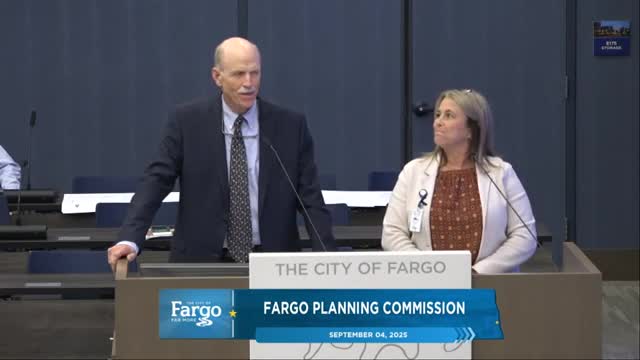
Summary
City attorneys updated the planning commission on a city-initiated annexation resolution for acreage north of the airport, explained the mediation/hearing process used when extraterritorial jurisdiction is contested, and answered commissioners’ and residents’ questions about timing, permitting and continuity of review.
City officials briefed the Fargo Planning Commission on Sept. 4 about recent annexation resolutions and a potential jurisdictional dispute with the neighboring city of Harwood. Eric Johnson, an assistant city attorney, and Brenda Derrig, assistant city administrator, described the city’s use of a resolution of annexation to begin the process, the steps that follow when another jurisdiction contests an annexation, and the likely timeline for mediation or administrative hearings. Johnson said annexation may be initiated either by a property-owner petition or by a city-commission resolution; the Northside annexation in question began with a city resolution. He explained that when proposed annexation overlaps another municipality’s extraterritorial jurisdiction, state law provides a process: the governor appoints a mediator, the parties attempt mediation, and if that fails an administrative law judge conducts a hearing and decides boundaries using statutory factors. “That’s sort of the underlying reasoning why our annexation process here led with an annexation resolution,” Johnson said, describing past litigation where the first official action gave a neighboring city a procedural advantage. Johnson acknowledged Harwood’s claim that roughly half of the west half of Section 3 lies in Harwood’s extraterritorial area; he said city commission resolutions covered several areas and that staff can circulate a detailed map to residents and commissioners after the meeting. Residents asked whether developers may proceed with permitting during the dispute; Johnson said developers generally can seek zoning and building permits from whatever jurisdiction currently has permitting authority. He and Derrig noted that if a building were permitted under Harwood’s authority and the property were later annexed by Fargo, the inspection and certificate-of-occupancy process would be coordinated as necessary. On timing, Johnson estimated mediation and potential resolution commonly take months — often three to six months, sometimes longer if a hearing is needed — and said the process can be faster when mediation succeeds. Commissioners asked for a map showing annexation boundaries and for staff to circulate it; Johnson said staff would provide a PDF showing the areas subject to the commission’s annexation resolutions. The briefing was informational; no commission vote was required and none was taken. Ending Johnson and Derrig encouraged individual questions to staff after the meeting and noted that group discussions raising quorum issues would be handled under open-meeting requirements. If mediation fails, the statutory administrative process determines the final boundary.