
Morton County approves Saint Anthony Commercial Park, permits Grama Butcher Shop and grants phased tax relief
Get AI-powered insights, summaries, and transcripts
Subscribe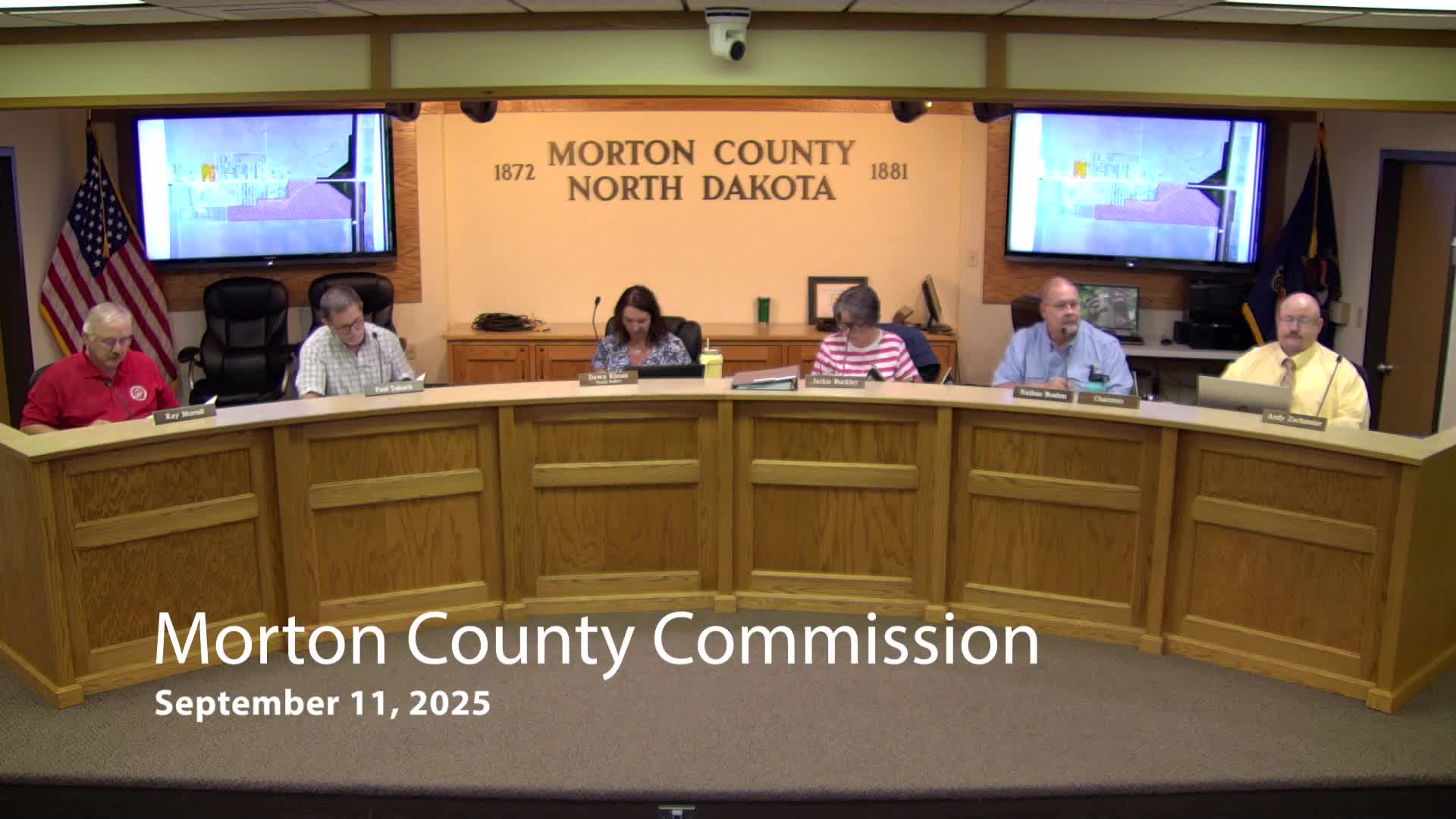
Summary
The Morton County Commission on Sept. 11 approved the Saint Anthony Commercial Park final plat and rezoning, granted a special-use permit to Saint Anthony Meats (doing business as Grama Butcher Shop) for a minor meat-processing facility with conditions, and approved a five‑year, phased property tax incentive for the business.
The Morton County Commission on Sept. 11 approved the final plat and zoning map amendments for Saint Anthony Commercial Park, granted a special‑use permit to Saint Anthony Meats (Grama Butcher Shop) to operate a minor meat‑processing facility on Lot 2, Block 2, and authorized a phased five‑year property tax exemption for the business. The commission approved the measures by voice vote or roll call; the tax incentive passed on a roll call with all commissioners voting yes.
The approvals clear several regulatory steps that the applicants said they need to open a small, custom meat‑processing operation serving local producers and residents. Planning and Zoning staff recommended approval of the subdivision and the special‑use permit with conditions; the road commission recommended a developer agreement tying hard surfacing to later development. County staff and the applicants explained the project’s anticipated scale and the public‑health and infrastructure conditions that will apply.
Saint Anthony Meats plans to operate as a custom‑exempt, minor meat‑processing facility, initially processing about 12 head of beef per week with the possibility of increasing to 15 after the business is established. Applicant Steven Goda said the operation would slaughter one day a week and process four days a week, producing roughly 24 vehicle trips weekly (12 drop‑offs, 12 pickups) plus employee trips. "I don't wanna take federal slaughter off of our radar," Goda said; he added that the business will begin as custom‑exempt and could pursue federal inspection later if systems are refined.
Planning staff told the commission the site can be served with three‑phase power and water from Missouri West Water. The site plan submitted to planning shows an on‑site septic drain field and reserved area for septic infrastructure; Western Plains Public Health recommended conditions. Natalie (planning and zoning staff) told commissioners she recommends referencing the county’s new minor‑meat‑processing performance standards (section 5‑270) rather than restating each element. She said the county’s standards will include a requirement for a flow meter and a one‑year usage report to Western Plains to confirm septic design capacity matches actual water usage.
Planning and zoning recommended approval of the subdivision and rezoning: three lots rezoned to commercial and one lot (Lot 2, Block 2) rezoned to industrial. County staff noted wetlands and a drainage easement reduce some buildable area on a lot near the Rodeo Grounds; staff said the industrial lot still has room for a septic system despite the easement.
The road commission asked for a developer agreement requiring hard surfacing when a certain development intensity is reached; the road commission’s draft would require hard surfacing once three lots are developed or certain uses (for example, a service station) are established. Mark Isaacs, an engineer representing developers, said recent conversations with property owners indicate a service station is less likely than earlier anticipated and that a service station or similar higher‑traffic use would itself justify hard surfacing. "If there was a station or any type of service that would go in there… that site plan would warrant putting hard surface in," Isaacs said.
Commissioners discussed whether to require hard surfacing now or develop a county‑wide rule. One commissioner said the county should direct planning and zoning and the road commission to draft a consistent paving rule for commercial and industrial subdivisions before imposing one site‑specific requirement. Planning staff confirmed the county is actively discussing a paving policy for residential subdivisions but has not adopted a county rule requiring commercial or industrial hard surfacing.
The special‑use permit for the Grama Butcher Shop was approved with four conditions recommended by planning and Western Plains Public Health: 1) the use must meet the performance standards in section 5‑270 for minor meat processing (except building setback standards not applicable to this application); 2) minimize use of cleaning chemicals to support septic function; 3) handle solid materials as solid waste and install fine grates on floor and sink drains to capture particles and hair; and 4) install two wastewater tanks with space between tanks to allow cooling and fat solidification before discharge to the drain field. The planner also noted a flow‑meter and a one‑year water‑usage reporting requirement are part of the county’s new standards.
Applicants provided a startup‑cost and projected‑revenue packet to commissioners at the hearing. The applicants and a family representative said they expect to open first as a custom‑exempt plant and, if successful, could later pursue federal inspection and value‑added processing. The applicants said their opening staff would be three full‑time and one part‑time employee and that they plan to hire more as demand grows.
The commission also approved a property tax incentive request for Saint Anthony Meats LLC. After discussion about precedent and local fiscal impact, commissioners approved a five‑year phased exemption: 100% property tax exemption for years 1–3, 50% in year 4, and 25% in year 5. A commissioner cited how the county handled a prior industrial incentive and proposed the same rollback structure; another commissioner estimated the county property tax on a $1.5 million taxable valuation would be roughly $9,000 per year (an applicant figure echoed in the discussion). The applicants had initially filed for five years; during the hearing one representative said they would be comfortable relinquishing an incentive if the business becomes profitable earlier.
Planning staff noted the Planning and Zoning Commission recommended approval of the subdivision, rezoning map amendments and the special‑use permit subject to the listed conditions. The commission also encouraged the applicants to investigate local economic development resources: a commissioner told the applicants about a Bismarck‑Mandan Chamber/EDC economic development fund that might provide additional support.
The approvals complete several local permitting milestones but do not create federal inspection status, require immediate hard surfacing of the new internal subdivision roads, or guarantee future county funding. County staff said the roads would be accepted by Morton County only if built to county specs; if gravel is used initially, the county’s current minimum is a 30‑foot road surface prepared for future hard surfacing. Commissioners directed planning and road staff to continue work on any county‑wide paving policy for commercial and industrial developments.
Speakers quoted or referenced in this article included Saint Anthony Meats owner Steven Goda; Mark Isaacs, engineer for the applicant; Natalie, planning and zoning staff; and multiple Morton County commissioners and staff during the public hearing and the roll‑call vote approving the tax incentive.
The commission approved the plat, zoning changes, special‑use permit and phased tax incentive during the Sept. 11 meeting.