
District 97 presents tentative budget showing $4.9 million non-capital surplus; board told cushion may shrink
Get AI-powered insights, summaries, and transcripts
Subscribe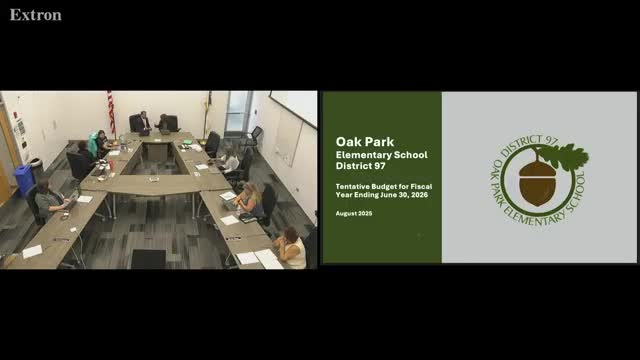
Summary
Consultant Rob Grossi and incoming CFO Dr. Crystal Leroy presented a tentative 2025–26 budget projecting a $4.9 million non-capital surplus and fund balances near a 155-day target. Board members discussed slowing revenue growth, CPI limits in Cook County, new-property estimates and the district's 3–6 month fund-balance policy.
Oak Park Elementary School District 97 officials presented a tentative budget and unaudited fiscal-year results at the Aug. 12 board meeting, reporting a stronger-than-expected year-end cash position and a projected non-capital surplus for 2025–26.
Rob Grossi, a consultant who regularly works with the board, said preliminary cash-basis results show the district started the fiscal year with about $44.2 million, received roughly $129.7 million in revenues, spent about $122.1 million and closed the year with about $51.8 million in the bank. Grossi said the district increased its fund balance by approximately $7.6 million and invested a little over $2 million in capital projects.
Grossi said the tentative budget projects total revenues and expenditures for the coming year that result in a $4.9 million non-capital surplus; $4 million of that amount is recommended for capital investment and the remainder to further grow fund-balance reserves. "Key takeaway is that we're projecting to realize a $4,900,000 non capital surplus," Grossi said.
Board members and staff noted the district relies heavily on property taxes (about 79% of revenue) and that, because Cook County is subject to tax caps, future revenue growth will be driven primarily by CPI adjustments and new taxable property. Grossi told the board the CPI cap for the 2024–25 fiscal year was 5% and is projected to decline to 3.4% and then 2.9% in subsequent years. He said an estimated $10 million in new taxable property (equal to about $30 million market value) typically produces roughly $400,000 in new tax revenue.
The presentation outlined expenditure pressures: salaries and benefits (about 75% of total expenses), negotiated contracts, increases in employee-benefit costs (projected at 5.5%), higher software purchases and an allowance for $4 million in capital projects in the coming year. Grossi said aggregate expenditures are projected to rise by about $7 million (7.1% overall; about 4.5% excluding capital).
Board members questioned whether the district should revisit its fund-balance policy — which sets a 3–6 month target — given volatility in state and federal funding, potential pension shifts, and federal-grant uncertainty. One member noted the board has earlier used abatement and other levers when reserves grew above policy targets. Grossi said some comparable districts maintain higher reserves and that the district ended the year with about 155 days of reserves.
The board was given a timetable for budget steps: a published notice calling a public hearing, a review session with the finance advisory group (FORC) on Aug. 26, a public hearing on Sept. 16 and a final board approval in September with filing to the Illinois State Board of Education thereafter.
Dr. Crystal Leroy, the district’s new chief financial officer, joined the presentation and said the materials are in draft form and that staff will continue to report quarterly and provide scenario modeling (best case, realistic, worst case) as the audit is completed and negotiations evolve. The board asked staff to consider scenario planning, operational efficiencies, and to prioritize instructional and student-facing programs in any future budget adjustments.
No final budget vote occurred at the Aug. 12 meeting; the board set a schedule to solicit public input and finalize the budget in September.