Get Full Government Meeting Transcripts, Videos, & Alerts Forever!
Get email alerts on the Instructional Partnership topic
No spam. Unsubscribe anytime.
District highlights year-long partnership with HMH to boost classroom rigor and engagement
Summary
At its Feb. 24 meeting, the School District No. 40 Board of Education heard a presentation from Dr. Rob Thornell of HMH about a year‑and‑a‑half partnership focused on classroom rigor, learner engagement and learning walks across district campuses.
Dr. Rob Thornell of HMH told the School District No. 40 Board of Education on Feb. 24 that the district’s year‑and‑a‑half partnership with HMH’s Center for Model Schools has focused on raising classroom rigor and student engagement across campuses. “The overwhelming majority of your classrooms are such positive learning environments,” Thornell said, adding that the work aims to “push all students toward high academic performance.”
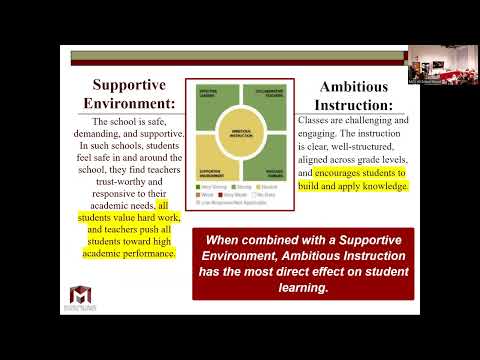
The presentation summarized work completed since last summer and laid out the near‑term plan. Nut graf: District leaders said the collaboration emphasizes two of the Illinois 5 Essentials—ambitious instruction and supportive environments—and uses classroom observations and rubrics to target quality of student discussion and academic personalization, which the consultant flagged as priority areas.
Thornell said he conducted 54 formal classroom observations and participated in about 60 additional walkthroughs with principals and teacher leaders. He described a schedule of learning walks that the district is conducting across campuses: a planned 12 days of structured visits during the school year (eight completed, four remaining), with the goal of visiting about 22 campuses by May and running high‑school walkthroughs as single‑day events. Thornell said one recent day included about 45 classrooms observed — “21 at Wilson and 24 at Deere,” he said — and that the walks emphasize descriptive, not evaluative, feedback for teachers.
Board members and district staff described professional learning sessions Thornell led: a short districtwide presentation last August, four half‑day sessions with instructional coaches, and two half‑day sessions with principals. The Center for Model Schools’ work uses rubrics for rigor, relevance, learner engagement and relationships to assess and improve instruction, Thornell said.
District representatives said the partnership has also led to teacher‑to‑teacher learning, with teachers conducting their own walkthroughs and sharing practices. A board member who spoke after the presentation said the partnership has “helped gain some strong momentum” toward the district’s 5 Essentials goals and praised teachers for opening their classrooms to peers.
The presentation closed with a note that the district was invited as one of seven “innovative districts” nationally to represent the area in Washington, D.C., and with thanks to staff leading implementation. No formal board action was taken on the presentation; it was an informational update and discussion only.
The board did not set new policy during the presentation; follow‑up direction consisted of continuing the learning walks and incorporating feedback into principal and teacher practice as part of the district’s ongoing 5 Essentials work.