
Maine Township HSD 207 accepts Empower Ed review, staff outline multi-year plan to expand inclusive instruction
Get AI-powered insights, summaries, and transcripts
Subscribe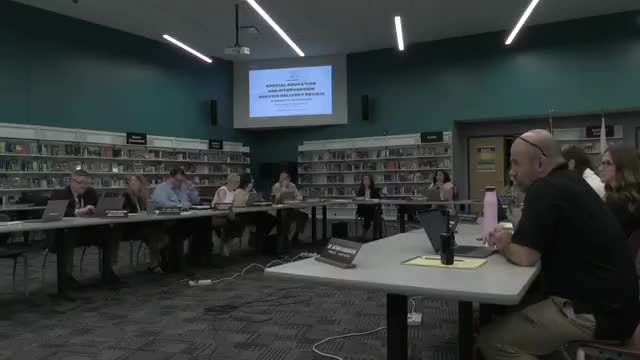
Summary
A consultant team presented findings from a year-long program review of special education services in Maine Township HSD 207, noting gains in general-education access but recommending a district steering committee, expanded professional learning, staffing reconfiguration and clearer IEP communication across a three-year implementation timeline.
Maine Township HSD 207 heard a program-review presentation May 19 from Empower Ed, an education consulting firm, that found measurable gains in inclusive practice but also recommended changes to increase access to the general-education curriculum for students with disabilities.
The report — summarized for the district’s finance committee by Empower Ed consultant Kate Small — said the district has strengthened co-teaching and inclusion facilitation and recorded a 5.4% increase in the share of students spending 80% or more of the day in general education between 2022–23 and 2024–25, an increase the consultant estimated is roughly 40 students.
Small framed the district’s findings against legal and research standards. “The Individuals with Disabilities Education Act supports the idea of the least restrictive environment,” she said, adding that 50 years of research supports inclusive education as a practice that benefits students with disabilities and their general-education peers. She told the committee Empower Ed’s review combined document analysis, surveys and focus groups, analysis of district data and a September 2024 site visit in which consultants observed 98 classrooms across the district’s three high schools, Frost Academy and the transition program.
The review identified strengths and weaknesses. Strengths included a districtwide commitment to inclusive settings, a warm and welcoming classroom environment (noted as fully or substantially implemented in 92.8% of visits) and classwide routines visible in 84.7% of visits. Co-teaching sections grew from about 18.5 in 2023–24 to 42 in 2024–25 and are projected to reach about 83 in 2025–26, the presentation said. Students with Individualized Education Programs (IEPs) in the district outperformed the state average on the Illinois science assessment for that demographic, the consultant added.
But the report also flagged areas for growth. District data showed that Maine Township’s percentage of students participating 80% or more in general education is 42.9%, below the state average cited in the presentation (54.4%) and a national benchmark shown on the slide (67.9%). Snapshot observations found lower rates of instructional practices that support student agency: only 21.6% of classrooms fully or substantially provided multiple access points or choices to reach lesson goals, and only 14.9% showed fully or substantially evident instructional scaffolds in materials.
The review also examined out-of-district placements. Empower Ed reported that students with autism make up 19.1% of students with disabilities in the district but 33% of out-of-district placements; students with emotional disability comprise 13.1% of the special-education population but 25% of outplacements. Hispanic students were 25.6% of total enrollment but 36% of out-of-district placements, and male students represented 73% of out-of-district placements. The consultants noted that some placement decisions arrive with students as they transition into the high-school district, which limits district control over prior placement choices.
Empower Ed recommended four principal actions for the district: form a district-level steering committee that includes parents, students and staff to guide inclusive opportunities; prioritize professional learning that connects existing teacher skills to inclusive practices; consider restructuring special-education staff deployment and paraprofessional assignment to expand student access to general education; and develop clearer, consistent IEP meeting practices and published guiding documents for families and staff. The firm provided a suggested timeline: 2025–26 as a planning year, 2026–27 for implementation of flexible service-delivery models and expanded access, and 2027–28 for refinement and stakeholder-driven adjustments.
District staff said some steps have already begun. The board heard that Empower Ed has been used for co-teacher and inclusion-facilitator training and that joint curriculum work is in progress so special-education teachers are involved earlier in course design. When asked about expected timing for measurable changes, the presenter said indicators of least-restrictive-environment (LRE) placement can show improvement in about two years, while academic achievement gains typically take longer.
Board members and staff asked several clarifying questions during the discussion, including whether Frost Academy could function as a step-down program to reintegrate students from out-of-district placements and how classroom space and paraprofessional deployment would affect reintegration. District staff acknowledged that physical space and program design would need attention if more students return from outplacement.
The district received an executive summary of the full report; the presenter said the complete report is available on request. No formal board vote or policy change was taken at the meeting; staff described the presentation as a basis for planning and continued partnership with Empower Ed for professional development and implementation support.
For now, the district will use Empower Ed’s recommendations to guide planning and training decisions, while tracking LRE indicators and instructional-quality metrics in follow-up reports to the board.