
District 207 consultant report urges expanding inclusive special-education practices
Get AI-powered insights, summaries, and transcripts
Subscribe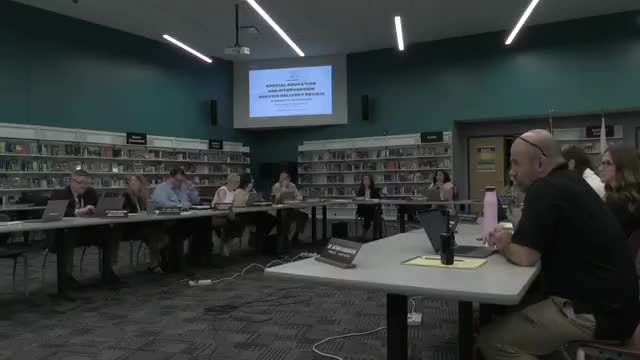
Summary
A consultant report presented May 19 to the District 207 finance committee found gains in co-teaching and inclusion facilitation but recommended structural, staffing and communication changes to increase access to general education for students with disabilities.
A consultant from Empower Ed told the District 207 finance committee on May 19 that the district has made measurable gains in inclusive special-education practices but needs further structural and staffing changes to bring more students into general-education classrooms. Kate Small, an Empower Ed consultant who led the district review, said the report lays out a multi-year plan for planning, implementation and refinement.
The review matters because federal law (the Individuals with Disabilities Education Act) and long-standing research favor teaching students with disabilities alongside general-education peers when appropriate; district officials report the district is still behind state and national averages on that measure. "Creating inclusive schools really is the first step towards creating a society where everyone feels seen, supported, and valued," Small said.
Empower Ed described a year-long service-delivery review that combined document analysis, surveys, focus groups and a site visit. Consultants observed 98 classrooms in September 2024 across the district’s three high schools, Frost Academy and the district transition program; 59 of those were general-education classrooms and 39 were special-education classrooms. The firm compared those observations with district and state data to identify patterns and align findings to evidence-based recommendations.
Key findings included a district-level increase in least-restrictive-environment (LRE) participation and growth in co-teaching: district students participating 80 percent or more in general education were reported at 42.9 percent, compared with a state average the consultant cited at about 54.4 percent and a national target of roughly 67.9 percent. Empower Ed said District 207 improved about 5.4 percentage points from the 2022–23 to the 2024–25 school year — roughly 40 additional students now spending more time in general education — after expanding co-taught sections from about 18.5 sections in 2023–24 to 42 sections in 2024–25, with a projected increase to 83 sections in 2025–26.
Classroom-observation quality indicators were mixed. Empower Ed found high rates of positive environment and routines (92.8 percent of visited classes were rated warm and welcoming; classwide procedures and physical spaces were substantially implemented in about 84.7 percent of classrooms). By contrast, student-centered instruction and scaffolding showed room to grow: the indicator for students being provided multiple access points or choices was fully or substantially implemented in 21.6 percent of visits; instructional scaffolds in materials were fully or substantially implemented in 14.9 percent of visits. The firm noted the district’s rate for student-driven instruction (where students do most of the work and teachers act as facilitators) was 42.7 percent, above a national consulting benchmark of 27.7 percent for secondary classrooms.
Achievement data showed mixed results. Empower Ed reported that students with individualized education programs (IEPs) in District 207 outperformed the state average on the Illinois science assessment by about six percentage points, but students taking the state alternate assessment (the Dynamic Learning Map) showed no students at the highest proficiency bands. Consultants also identified disproportionality in out-of-district placements: students with autism make up about 19.1 percent of the district’s special-education population but accounted for about 33 percent of out-of-district placements; students with emotional disabilities were 13.1 percent of special-education enrollment but 25 percent of out-of-district placements. The firm also flagged demographic disparities: Hispanic students were 25.6 percent of district enrollment but 36 percent of out-of-district placements, and male students represented about 73 percent of out-of-district placements.
From those findings, Empower Ed offered four overarching recommendations: form a district-level steering committee that includes parents and students to guide inclusive opportunity expansion; prioritize professional learning that connects existing teacher skills to inclusive practices; consider restructuring special-education staffing and paraprofessional deployment to increase access in general education; and create clear, consistent IEP and program handbooks to improve communication and meeting facilitation. District staff told the committee some of the work has already started, including co-teacher and inclusion-facilitator training and collaboration between special education and curriculum staff. The district and Empower Ed plan a phased timeline: 2025–26 as a planning year, 2026–27 as an implementation year for expanded access and flexible service-delivery models, and 2027–28 for refinement and stakeholder feedback.
Committee members asked about specific patterns in the out-of-district placements and reintegration. A board member asked whether Frost Academy could serve as a step-down program for students returning from out-of-district placements; staff and consultants said Frost already facilitates some reintegration and that reintegration rates from Frost to home buildings exceed reintegration rates from private or public day placements outside the district. Consultants and staff cautioned that some placement decisions arrive at high-school transition and may be inherited from prior districts, which limits immediate district control.
The presentation and report include detailed action items under each recommendation; Empower Ed provided an executive summary to the board and said the full report is available to district stakeholders. No formal motion or vote on the recommendations was taken at the May 19 meeting.
Next steps listed in the presentation include continuing Empower Ed’s partnership for professional learning, staff-led resource mapping to examine paraprofessional deployment, forming the recommended steering committee, and revising handbooks and IEP facilitation practices. The district’s staff contact said the timeline in the report is a guideline and will be adjusted to fit local staffing, space and budget considerations.