
District 204 presents conservative 2025–26 budget; board debates levy practice and evidence‑based funding shortfall
Get AI-powered insights, summaries, and transcripts
Subscribe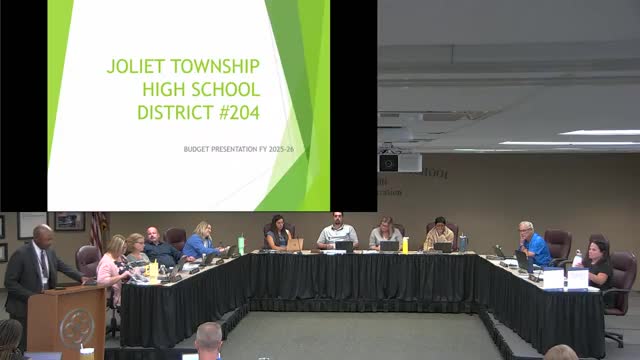
Summary
Joliet Township High School District 204 officials presented the district’s preliminary 2025–26 budget and defended levy and reserve strategy as the board debated whether to rebate taxpayers despite a funding shortfall under the state evidence‑based funding formula.
Joliet Township High School District 204 officials presented the district’s preliminary 2025–26 budget at the board meeting and answered questions about levy strategy, reserves and state funding shortfalls.
Doctor Hampton presented the tentative budget and said planners used conservative assumptions: Consumer Price Index (CPI) for the levy at 3.4 percent, projected new construction of roughly $38 million (down from an exceptional $215 million reported for 2023), and a 32 percent drop in Corporate Personal Property Replacement Tax (CPPRT) receipts — from about $16.3 million to $10.8 million in the most recent comparison. Hampton said evidence‑based funding (EBF) adequacy for the district has fallen to approximately 73 percent; the district expects an increase in nominal EBF dollars but a lower adequacy rate tied to other revenue reductions.
Hampton explained levy practice and reserves in response to board questions. “We levy what we're entitled to because if you don't levy it, you lose it forever and you never gain that back,” he said, describing the district’s approach to taking the full allowable CPI increase rather than under‑levying then rebating. He also said the board maintains reserves to avoid borrowing and to preserve programs and staff when revenue fluctuates.
Budget highlights and figures presented: - Revenue sources (most recent fiscal picture): ~74.4 percent local property tax, ~20.2 percent state aid, ~5.4 percent federal funds. - CPPRT: dropped from about $16.3M (2024) to $10.8M (2025 projection), a roughly 32 percent reduction noted by the presenter. - New construction: reported at $215M in 2023 and $38M in the current year projection (presenter described the $215M year as an outlier). - District estimated operating fund surplus of roughly $18.4M carried into the next year, with education fund budgeted around $105M and total projected expenditures across funds noted in the presentation.
Board debate and decisions: Board members asked whether the district should rebate taxpayers rather than levy the maximum and then return funds. Hampton and other speakers cautioned against rebates while the district remains below full evidence‑based funding and while grants and federal supports remain uncertain. One board speaker urged that until the district reaches full EBF adequacy, leaders should avoid reducing levy revenue.
Formal action taken: the board approved the tentative 2025–26 budget by roll call. The vote on the tentative budget recorded multiple yes votes and one abstention (Mister Fitzpatrick abstained); the motion passed and the tentative budget moved forward for the statutorily required public notice and final‑adoption steps.
Why it matters: levy choices, reserve levels and state funding adequacy directly influence class offerings, staffing and long‑term capital projects. Administrators told the board that they will continue to monitor legislative and federal developments and present updates as state revenue assumptions change.
Ending: The tentative budget was approved for publication and further review; administrators said they will return with a five‑year financial plan in February and update the board if material legislative or revenue changes occur before final adoption.