
Grand Forks County reviews benefit changes as health premiums project big rise
Get AI-powered insights, summaries, and transcripts
Subscribe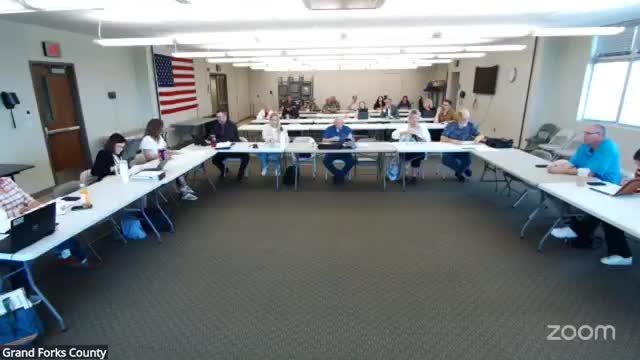
Summary
County staff told commissioners that insurer proposals could raise employer costs for 2026 by roughly $400,000–$800,000 depending on the premium increase scenario; officials discussed plan design changes, HRA versus HSA options, and options to equalize employer contributions across plan tiers.
Grand Forks County human-resources staff presented commissioners with options to respond to a projected large increase in health-insurance premiums for 2026, saying the county faces a potential 12%–19% rise that could push total employer premiums from about $4.2 million toward $5.0 million.
The county’s benefits presenter summarized drivers for the jump and spelled out design options commissioners could consider, including a narrower-network plan (Dakota Blue Ultra), changing how the county funds health-reimbursement arrangements (HRAs), and offering a health-savings-account (HSA)–linked plan. “Part of why so much this year is because we’ve been very lucky in the past,” the presenter said, listing market dynamics, new specialty drugs and increased utilization as factors.
Why it matters: higher premium rates would increase department personnel budgets countywide and could require either additional mill levy increases, budget cuts elsewhere, or tapping fund reserves. Commissioners pressed staff for concrete numbers to run through budget-cap calculations and for comparisons between current wide-network coverage and the narrow-network Dakota Blue Ultra option.
County staff said current employer premium shares are structured by tier: roughly 90% employer share for single coverage and about 82% for employee-plus-children or family plans. Using the county’s May 2025 enrollment snapshot, the broker’s illustrative scenarios produced approximate totals of $4.2 million at current rates, $4.7 million at a 12% increase, $4.8 million at 14% and about $5.0 million at 19%.
Staff reviewed design levers the county could use to limit cost growth. Those included: breaking out employee-and-spouse coverage to change who is eligible for employer subsidy; offering Dakota Blue Ultra as a lower-premium option tied to an HSA; and standardizing HRA funding to a single per-employee amount rather than funding by plan tier. The presenter said an HSA option was estimated at $600 per employee annually (about $50 per pay period) if the commission chose that level and noted the county could set a different contribution.
Staff also described the functional differences between HRAs and HSAs: HRAs typically are front-loaded by the employer (and unused balances revert to the employer), while HSAs are employee-owned and portable. The county’s current HRA funding levels cited in the presentation were $2,100 for single, $3,150 for single-plus-dependent and $4,200 for family coverage; staff suggested one uniform employer contribution was a potential simplification and source of savings.
Commissioners asked for more granular comparisons, specifically: provider-network breadth (the current Blue Cross network versus the Dakota Blue Ultra network), projected out-of-network payment differences, and a side-by-side of current plan cost-sharing versus proposed new-plan cost-sharing. The presenter agreed to provide a precise comparison of in-network and out-of-network reimbursements and clarified that the Dakota Blue Ultra option would be optional (an additional plan choice), not an automatic replacement of the county’s current plan.
On timing and next steps, staff said broker negotiations were ongoing, the official experience-rate window closes in September, and final premiums for 2026 would not be available until later in the year. Commissioners directed staff to provide: (1) a spreadsheet with updated premium scenarios and employer-cost impacts under 12%/14%/19% assumptions; (2) a comparison of current and proposed network reimbursement levels; and (3) a single‑amount HRA/HSA option for commissioners to consider in the next budget workshop.
Speakers quoted in this article spoke during the budget-workshop benefits discussion and are identified in the record; direct quotes are attributed to those speakers listed below.