
Planning commission approves freshwater holding pond for oil-field water storage
Get AI-powered insights, summaries, and transcripts
Subscribe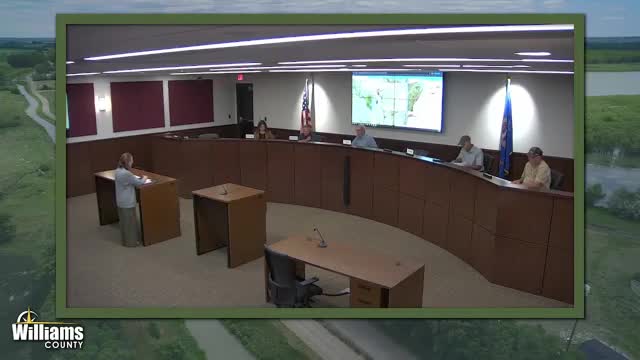
Summary
Williams County Planning and Zoning Commission approved a conditional use permit for a 49.9-acre-foot freshwater holding pond to support oil-well operations; staff said the pond will be lined, fenced and served by a Blue Ridge industrial well.
The Williams County Planning and Zoning Commission approved a conditional use permit to construct a freshwater holding pond for use in oil-well production on a roughly 155-acre parcel in Blue Ridge Township. Heather Brewer, representing Hamlin Water, described the project during the commission’s meeting. The pond would be located in the northeast-southeast quarter of Section 17, Township 159 North, Range 100 West. "The pond will be approximately 49.9 acre-feet," Brewer said, and she provided site details during staff presentation. The commission’s nut graf: the permit allows a lined, fenced storage pond intended to supply freshwater for nearby oil production; county staff reviewed the application and no township comments were on file at the time of the hearing. According to Brewer, the pond footprint would measure about 500 by 235 feet with a maximum slope of 3:1, and it would be lined with plastic, enclosed by fencing and have seeded berms for erosion control. "Purpose of this pond is for storage of fresh water to be utilized in oil well production," Brewer said. Pumping equipment would include a riser from the pond to a nearby production pad, and the pad would be equipped with a diesel pump and mobile water-transfer equipment. The water source was identified as the Blue Ridge Water Industrial Water Well, and access to the site is from North Dakota Highway 85. No members of the public spoke during the hearing. Commissioner Brett Brothers made the motion to approve the conditional use permit with staff comments; the motion was seconded by Commissioner Simonowski and passed on roll call. The record shows affirmative votes from Commission members present. The commission noted no township response had been received before the hearing; recordation or any permit conditions tied to construction (for example, erosion control and fencing) will be handled through county permitting and inspections. The approval allows construction under the county’s conditional-use process; any required state or federal permits (for example, for water appropriation or transport) were not discussed at the hearing and would be pursued separately if required.