
Council asks staff to draft facility‑naming ordinance after workshop; establishes petition thresholds and honorary‑name approach
Get AI-powered insights, summaries, and transcripts
Subscribe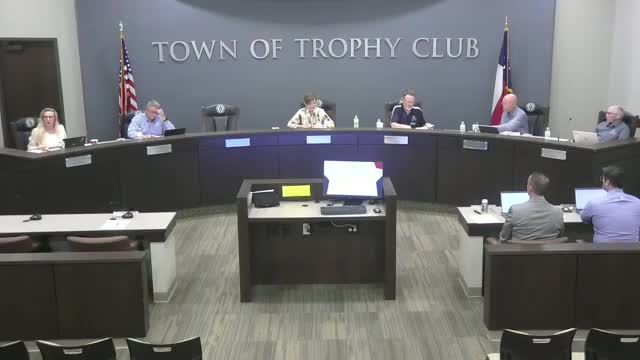
Summary
Trophy Club, Texas — Town council members and staff held a workshop on Sept. 8 to shape a draft ordinance for naming and renaming town facilities.
Trophy Club, Texas — Town council members and staff held a workshop on Sept. 8 to shape a draft ordinance for naming and renaming town facilities. The council did not adopt an ordinance at the workshop; instead members discussed policy options and directed staff to incorporate the council’s recommendations into a draft ordinance for future formal consideration.
Why it matters: The town has not had an ordinance governing how parks, buildings, streets and smaller features are named or renamed. Council members described the proposed policy as a way to create a predictable, community‑oriented process that reduces ad hoc decisions and clarifies when renaming is appropriate.
Key points from the workshop:
- Process and authority: Staff noted street names created through the subdivision/platting process would remain under the planning process; the town council retains final decision authority for naming and renaming of town facilities. The workshop was framed as a policy discussion only — no ordinance was presented for adoption that night.
- Exceptional circumstances and living honorees: The draft policy’s working principle is to avoid renaming major facilities except for “exceptional circumstances,” such as recognition of an exceptional individual or revocation of a name that no longer represents town values. The draft and council discussion also included a recommendation that honorees for facility names be deceased to allow full consideration of their life and contributions.
- Themes versus individuals: Several council members favored continuing the town’s tradition of naming major parks after community themes (examples cited were Harmony, Independence and Freedom parks) rather than after individuals.
- Signature requirements and petition rules: For public‑initiated requests the council supported a requirement that petitions include verifiable signatures from property owners in Trophy Club (landowner’s full written name and address, one signature per property). The council settled on a working threshold of 50% of property owners on a street for honorary street naming requests. Council members also discussed tiers for larger requests: the group settled on a working standard of 250 verifiable signatures for naming or renaming a major facility and 125 verifiable signatures for a minor facility (a minor facility being a feature inside a larger facility, such as a conference room or a ballfield within a park).
- Streets and honorary names: Council members agreed to remove full street renaming from the draft policy because of practical costs and disruption to property owners. Instead the policy will allow honorary street names (plaques or placards under street signs) that do not change postal addresses; those honorary designations would require verified neighborhood support (the 50% threshold for property owners along the affected street was discussed as the working approach).
- Exemptions and examples: Council members suggested excluding long or primary corridors from the renaming/ honorary process — specifically Indian Creek Drive, Trophy Club Drive and Bobcat Boulevard were cited as streets the town would not alter under this policy because of scale and community identity concerns.
- Major gifts and donor recognition: The draft policy included naming in recognition of major gifts. Council members asked to define “significant portion” of capital cost in clearer terms. During discussion an informal preference emerged for a donor contribution threshold (the council conversation coalesced around a 60% contribution figure as a working benchmark), and staff indicated the draft ordinance will define the required contribution more precisely.
- Council member submissions and limits: The draft policy as discussed would permit council members to sponsor a naming request; the draft under discussion proposed limits (for example, each council member could sponsor or second a request only once in a specified period — the draft used one request per three years as the working approach).
- Process timeline and review steps: Staff described a procedural timeline: an application and petition submitted to the town secretary, a 30‑day staff review for impacts (public safety, financial impact of signage, appropriateness under policy), referral to the relevant advisory board (for example, Parks & Recreation for park naming), and then council consideration. If the recommended action is a renaming of an existing facility, the draft would require published notice, a public hearing and notification to property owners within 200 feet of the affected facility.
- Memorial plaques and recognition: Several council members proposed a separate, simpler process for non‑naming memorial recognition (for example, a park plaque listing volunteers or donors). Staff and council agreed that placing memorial plaques or a memorial monument could be handled under a different policy or agenda item rather than via the formal facility‑naming ordinance.
Next step: Council directed staff to use the workshop discussion to prepare a formal ordinance and bring it back to council for consideration and possible adoption at a future meeting. No binding policy or ordinance was adopted at the Sept. 8 workshop; staff will incorporate the council’s recommended thresholds and process elements into the draft ordinance.