
Kennedale planning commission approves rezoning to industrial for landfill parcels; transfer station still requires future approvals
Get AI-powered insights, summaries, and transcripts
Subscribe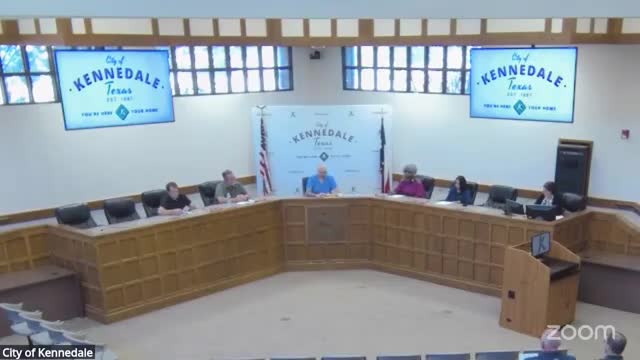
Summary
The Kennedale Planning and Zoning Commission on July 24 unanimously approved a zoning change to I (industrial) for five adjacent, unplatted tracts near the Fort Worth C&D landfill, commissioners heard.
The Kennedale Planning and Zoning Commission on July 24 unanimously approved a zoning change to I (industrial) for five adjacent, unplatted tracts near the Fort Worth C&D landfill, commissioners heard. The properties — described in the hearing as portions of the 400 block of Price Road and surrounding parcels — are currently zoned C-2 (general commercial) and R-3 (single-family residential).
The rezoning, presented by Chuck Marsh, a civil engineer with Weaver Consultants representing Waste Connections, would consolidate the five tracts (just shy of 10 acres in total) into a single lot and change the zoning to industrial. “This is consistent with the city's future land use plan,” Marsh said during his presentation, describing a possible future citizen drop-off area and other site improvements.
The change matters because industrial zoning would permit activities not allowed under the existing C-2 and R-3 designations and is a prerequisite for any future transfer-station or citizen convenience center on the site. Staff recommended approval, noting the proposal aligns with the city’s comprehensive plan and future land use plan and that the tracts are the only portion of the applicant’s operation inside Kennedale city limits; the landfill proper lies in the extraterritorial jurisdiction (ETJ).
Applicants and staff described the proposal as largely a site reconfiguration: relocating the facility entrance roughly 800 feet north, consolidating parcels, moving scales and an office (the proposed office building was described as about 4,900 square feet), and making traffic-flow improvements. “We're proposing to move that entrance approximately 800 feet north,” Marsh said, adding that relocating the entrance would “provide greater visibility, and also provides the ability to widen these driveways, make some improvements and overall just improve the traffic flow into and out of the current landfill site.”
Gary Bartles, regional engineer for Waste Connections, told the commission the rezoning would allow the company to move existing entrances and internal operations and eventually offer a citizen convenience center for municipal solid waste, but he emphasized that a transfer station is not guaranteed. “It may or may not happen on this property at that location,” Bartles said. He described the transfer-station concept as “visionary” and subject to future permitting and approvals, including TCEQ registration and any city approvals.
Traffic and timing drew several questions from commissioners. The applicants presented an engineering analysis projecting a worst-case increase of up to 1,136 total two-way vehicle trips per day if a transfer station operated at the permit cap (described in the presentation as a TCEQ cap of about 3,000 tons per day). The presentation estimated roughly 10% of daily trips would occur in the peak hour — about 114 trips — which the applicant framed as manageable. Marsh said TxDOT reviewed their traffic materials and had “provided no comments or objections” to the information supplied for the study.
Bartles said a development timeline to see any measurable traffic increase would likely be 18 to 24 months to begin construction and that reaching a theoretical maximum would take longer and depend on market factors. The applicants said TxDOT AADT counts and population projections informed their analysis and that permit limits would cap daily vehicle counts tied to tonnage.
The company also told commissioners it already pays the city 37 cents per ton on material received at the facility, which the applicant estimated yields roughly $175,000–$200,000 a year now and could increase to an additional $300,000–$400,000 per year if transfer-station tonnage approached the maximum described in the TCEQ materials. Bartles said the payments are made to the city per ton handled, and that any future increases would likewise increase payments to the city.
Staff explained that rezoning must happen before the applicant can consolidate the five tracts into a single platted lot; the applicant has submitted a plat that staff said is under review. Staff also noted that an industrial designation with a special exception would be needed for any citizen drop-off center and that a future public hearing and any required special exception process — and TCEQ permitting for a transfer station — would still be required before those uses could begin.
No members of the public had signed up to speak on the item. After discussion, a motion to approve the zoning change (the hearing referenced the item earlier as PZ case 2509; the motion recorded in the minutes refers to PZ case 02/1400) passed unanimously. The commission did not take any separate action on transfer-station permitting, special exceptions, or TCEQ matters — those remain future steps if pursued by the applicant.
Commissioners asked about debris and street cleanliness. Company representatives said they operate daily litter pickup and sweeping along Price Road, use controls inside the facility to limit track-out, require tarps on incoming loads, and may hire third-party sweepers to keep the adjacent right-of-way clear.
The zoning change approval allows the applicant to proceed with the city’s plat review and preserves the option to pursue future approvals for transfer-station or citizen drop-off uses; those uses would require additional city approvals and state permits before they could operate.