
East Chicago superintendent receives annual English-learners report outlining staffing shortfalls and program goals
Get AI-powered insights, summaries, and transcripts
Subscribe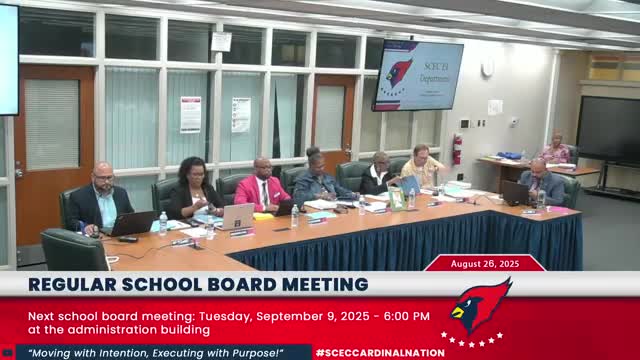
Summary
The district’s director of English learners reported 817 current English learner students, growth in exited students, and gaps in bilingual staffing; the board discussed Title III funding, parent advisory council plans and a multilingual celebration.
Xochitl Medina, the district’s director of English learners, presented the English Learner (EL) annual report at the Aug. 26 School City of East Chicago board meeting, outlining enrollment, program requirements and staffing needs. "Our program is designed to teach the students enough academic English to have native or near native English proficiency in the general education classes," Medina said, summarizing the program’s purpose. The report said the district currently serves 817 English learners, with Hispanic students comprising 54.4% of district enrollment as of Aug. 11, 2025. Medina told trustees there are 38 EL teachers districtwide, 3 dual-language teachers at Harrison Elementary, and 60 teachers trained in SIOP out of 238 (about 25%). She reported 13 students exited the EL program in 2023, 24 in 2024 and 27 so far this year; students who exit are monitored for two years. Medina said the district uses WIDA assessments and an ESL curriculum K–12, and that Title III grant funds pay for professional development stipends and family engagement materials. Trustees pressed on funding and federal changes. Trustee Rodriguez urged the district to watch a U.S. Department of Education proposal that would consolidate several grant “pots” and could affect Title III allocations; Medina said the district’s Title III award is a two-year grant and that the district is approved through 2027. Medina described new tools and processes: PowerSchool is being used to store Individual Learning Plans (ILPs) for every EL; an alternative-access screener is in place for students with special needs; and EL walkthroughs will be conducted monthly. Board members discussed parent engagement and cultural events. Medina said she will form a bilingual parent advisory council with four required meetings and is planning a multicultural celebration in April or May, tentatively at Todd Park. Trustee Taylor suggested scheduling events during Hispanic Heritage Month to avoid perceived exclusion; Medina said the intent is to include all represented cultures. Medina emphasized bilingual staffing shortages as the primary need. "We need more bilingual social workers, bilingual counselors, bilingual deans, bilingual office staff at the schools," she said, noting state limits on ratios (maximum 1:30 students per mandate) and that only three EL-certified classroom teachers are currently teaching in the district. She asked the board to prioritize professional development (including attendance at the National Association for Bilingual Education conference) and purchasing native-language instructional materials. The presentation concluded with a five-year strategic plan Medina distributed to trustees describing assessment and foundation work in year one, expansion in year two, institutionalization in year three and sustainability in years four and five. No formal board action was taken; trustees thanked Medina and discussed follow-up steps.