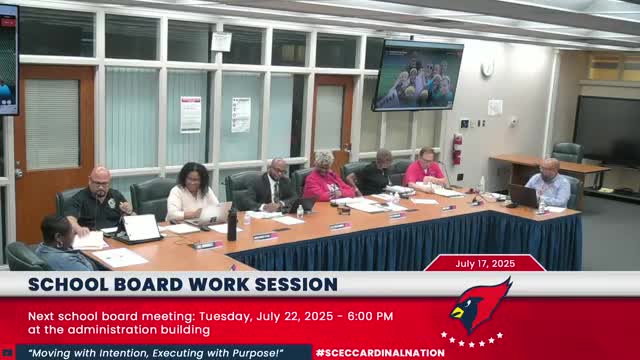
Trustees question claim docket items and conference approvals during July 17 work session
Summary
Trustees reviewed the claim docket on July 17 and pressed staff for explanations on returned checks, hotel charges for conferences and other invoices; they reiterated that conferences should be board‑approved before expenses under a new policy effective July 1.
Board members examined the claim docket and asked questions about multiple line items, including returned checks, conference hotel charges and payments for professional development. The July 17 work session included repeated trustee requests for clearer advance notice on conference approval and for better inclusion of claim backup documentation in the board packet.
Why this matters: the claim docket is the board’s financial control instrument for reviewing payments and ensuring proper approvals. Trustees flagged several items where invoices dated from prior months were being paid, and they reiterated that under a recently adopted policy, conferences and related expenses should be presented for approval in advance when possible.
Examples of discussion: trustees asked about check #118207 and an associated claim (88104); staff explained that student interns had cashed checks that were not entered into the bank's positive‑pay system, causing returned checks and reissued payments. Trustees asked about Model Schools Conference travel (hotel and attendees); staff said the travel predated the new July 1 conference approval rule and said staff would provide a report to the board on conference attendees and conference details. Trustees also asked about dues (National School Board dues) and other invoices; staff identified the nature of several claims (hotel reservations, PD payments, Walmart charges for back‑to‑school rally supplies).
Board policy and process: trustees reiterated that starting July 1 the board expects conference and travel requests to be approved before payment, and staff confirmed that for future conferences the board will see requests in advance. Trustees asked for clearer presentation of claim numbers and corresponding check numbers and asked staff to provide backup documentation in the packet.
Outcome: staff answered many line‑item questions during the session and committed to providing missing backup documentation and a post‑fact report on recent conferences that predated the July 1 policy. No claims were singled out for reversal during the session; the review was informational.