Get Full Government Meeting Transcripts, Videos, & Alerts Forever!
Get email alerts on the Education Services Contracts topic
No spam. Unsubscribe anytime.
School City of East Chicago staff brief board on renewals for Parent Cafe partners and special-education contracts
Summary
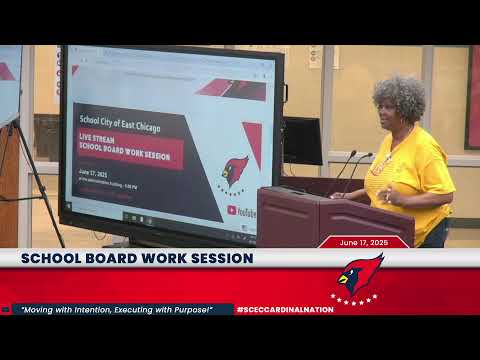
At a June 17 work session, school staff described annual contract renewals for district community partners that operate the Parent Cafe and for special-education service vendors, emphasizing free student services, Medicaid billing support and reading interventions. No formal board vote was recorded at the work session.
School City of East Chicago staff on June 17 presented the board with contract renewal requests covering the Parent Cafe’s community partners — including Girls on the Run and a range of nonprofit service providers — and multiple special-education vendors that support IEP services, Medicaid billing and reading interventions.
Staff said the Parent Cafe partnerships provide wraparound supports to students and families at no direct charge to the district, while the special-education contracts maintain essential services such as IEP-writing assistance, sign-language interpretation, Medicaid billing and alternative-placement counseling.
Vanessa Vasquez, a Washington Elementary teacher who served as a coach for Girls on the Run, described the program’s spring season and asked the board to renew the district’s MOU. "It didn't cost them anything," Vasquez said of participating students, and she outlined program details including coaches' training, twice-weekly practices and a culminating 5K. She said each elementary team had about 10 to 12 girls and that the foundation provided shoes, shirts and lesson materials.
Rita Daniels, the district’s Parent Cafe coordinator and a school social worker at Central High School, summarized the district’s partner organizations and the services they provide. Daniels said partners include Fair Haven (child abuse and exploitation prevention programming), Jimenez/Community Partners (community-based mental-health services and connections to a network of more than 50 providers), Top 20 Dance (arts instruction and meal support for McKinney‑Vento families), HealthLinc (medical-navigation and legal-aid referrals), Purdue Extension and the Northwest Indiana Food Council (farm-to-school and school garden programming), WiserSource (Spanish-language mental-health services for English learners), Healthy Hearts/Healthy Minds (sports-focused mental-health supports) and Mental Health America (pre-K “Ready to Soar” developmental screening).
Daniels said many of the partners provide services at no charge to the district and that some agreements are new (WiserSource) while others have existed for years. She noted Purdue Extension was experiencing "hiccups" due to funding cuts but that local farmers continued to participate in farm-to-school work. Daniels also identified community collaborators including the East Chicago Fire and Police departments, Catholic Charities (which supplies food for Central High’s McKinney‑Vento students) and local churches that run food banks.
Patricia Koulianos presented a high-level overview of special-education contract renewals. She described an IEP-writing rider used to support new and elementary teachers (a paid retired-teacher assisting with IEP paperwork while new teachers learn the process) and TradeWinds for sign-language interpreters. Koulianos said AssetWorks (formerly GoSolutions) handles Medicaid billing that allows the district to seek reimbursement for related services such as occupational and speech therapy. She said Infinity Counseling is an alternative-placement resource the district has rarely needed but keeps available for crisis placements, and Readable English — funded through the special-education fund — has been used three years as a reading intervention with reported gains. EverWay (formerly N2Y) provides curriculum for applied-skills classes and transition planning for students with moderate-to-severe needs. Koulianos noted the district is switching to PowerSchool’s IEP platform statewide and that the change will require teacher training.
Daniels and Koulianos answered board questions about oversight and data reporting. Trustees requested quarterly or regular summaries showing usage and outcomes for contractors; Daniels and staff agreed to provide such updates. Koulianos reported Central High School finished the year with about 234 active IEPs, and she outlined that applied-skills classes at Central now serve roughly 40–45 moderate-to-severe students.
No formal vote on the renewals was recorded during the work session; staff said renewal contracts were on the board packet for follow-up at the board’s regular meeting.
Ending: Staff recommended that the board renew the listed partner MOUs and special-education contracts so services can continue into the coming school year. Trustees asked that future reports include concise outcome or usage data to support ongoing renewals and budgeting.