
Council approves Heffner mixed-use rezoning despite neighborhood demands for larger buffer
Get AI-powered insights, summaries, and transcripts
Subscribe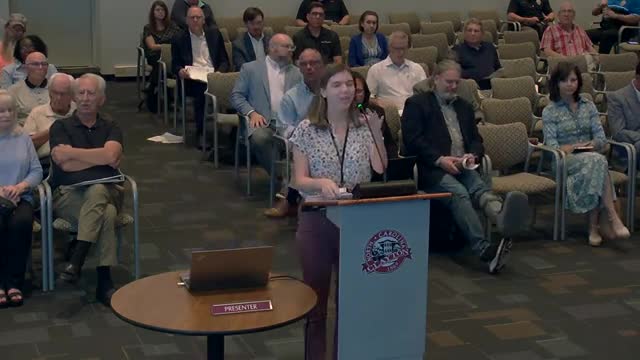
Summary
The Clayton Town Council on Aug. 19 approved a conditional rezoning for 74.08 acres east of Johnston Charter Academy that will allow a mixed‑use development of commercial and multifamily uses, while adopting conditions including a 40‑foot perimeter buffer and an emergency‑access‑only connection to the neighboring Dogwood Forest subdivision.
The Clayton Town Council on Aug. 19 approved a conditional rezoning that clears the way for a 74.08-acre mixed-use development along Clayton Boulevard, including about 51 acres of commercial space and roughly 16 acres of multifamily housing. The council adopted the developer’s concept plan and a set of conditions that tie the plan to the land.
Supporters and the applicant said the project will bring retail and housing to the town and include traffic and stormwater improvements. Tom Lowell of Casto, the project developer, told council, “We hope it's going to be a successful project, not just for us, but for Clayton and the community.” Assistant Planning Director Haley Downey summarized the plan’s limits, saying the application “are limiting up to 12 units per acre for development for the multifamily component.”
Why it matters: the site sits east of Johnston Charter Academy and adjacent to the Dogwood Forest subdivision. Residents said they accept development but asked the council to preserve a larger natural buffer than the one proposed and to require stronger protections for stormwater, noise and construction access. "We are not against this project," Dogwood Forest resident Bill Brewer said during public comment. "We, as residents of Dogwood Forest, want to be assured that our quality of life is protected."
What the council approved: the rezoning switches two parcels from CRM (Corridor Commercial) and RLL (Residential Large Lot) to CCC (Conditional Commercial). Key conditions adopted by council include: a 40-foot perimeter buffer along the neighborhood edge (the applicant also committed to all‑evergreen plantings in that buffer), a requirement that the parcels be annexed before construction drawing approval to receive town services, two on‑site stormwater ponds to be designed and permitted through the town’s stormwater review, and several traffic improvements required by NCDOT. The council also accepted a new condition proposed by the applicant clarifying that the cross‑access from the site to Lightfoot Drive would be “for emergency services only” and would be gated with Knox Box access.
Residents asked for more. Dozens of Dogwood Forest neighbors urged council to preserve a 125‑foot undisturbed separation that they say was expected from earlier rezonings and town decisions. Speakers described concerns about stormwater runoff into Little Creek, nighttime light and noise, construction traffic, and pedestrian access from the development into the neighborhood. Art Mercer told the council the earlier 125‑foot line on zoning maps had been intended as a protective separation and asked the council to honor it.
Developer concessions and details: Casto said it moved a stormwater pond and revised building locations after community meetings. The developer committed to a 40‑foot opaque buffer (type D) using evergreen trees and shrubs, to limit multifamily density to 12 units per acre, and to design emergency access that meets fire‑access load requirements and uses a Knox Box. The applicant’s traffic consultant said the study, vetted by NCDOT and town staff, projects build‑out traffic in 2030 and requires signal and turn‑lane improvements along U.S. 70; the developer also estimated a capital investment on the order of $125 million and projected long‑term property tax and sales tax revenue to the town.
Procedure and vote: Planning staff recommended approval with conditions as consistent with the town’s Comprehensive Plan 2045; the Planning Board had also recommended approval. After discussion, council voted to approve the conditional rezoning and the package of conditions; the motion carried.
Next steps and follow‑up: If the rezoning stands, the concept plan and conditions will “run with the land.” Site plans, construction drawings, stormwater designs and any traffic‑study updates required by condition must be approved by town staff and NCDOT as applicable. Residents asked the council and the developer to commit to periodic neighborhood updates during design and construction; the applicant said it was willing to provide notices and meet as the project advances.
Clarifying note: the council’s approval does not itself authorize construction; later site plan, engineering and permitting approvals are required before ground‑disturbing work may begin.