Get Full Government Meeting Transcripts, Videos, & Alerts Forever!
Get email alerts on the Superintendent Search topic
No spam. Unsubscribe anytime.
Santa Fe Public Schools holds superintendent finalist forums as community presses candidates on literacy, equity and staffing
Summary
Santa Fe Public Schools held two public forums April 30 to hear from three finalists for superintendent. Candidates faced questions from parents, students, teachers and union representatives about literacy instruction, standards-based grading, bilingual programs, staff retention and attendance; the board met in executive session afterward and reported no hiring action.
Santa Fe Public Schools held two superintendent-finalist community forums on April 30, 2025, where three finalists — Dr. Neil Weaver, Dr. Fabiola Cantu and Dr. Christine Griffin — answered questions from parents, students, teachers and community members about literacy, equity, staffing and school operations.
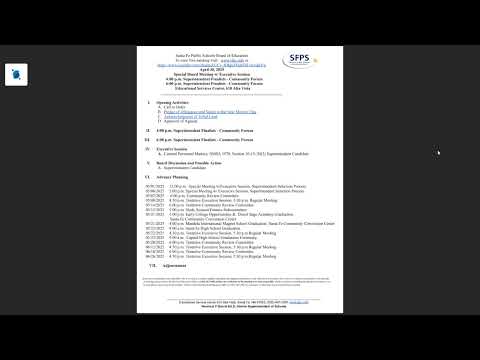
The forums, at 4 p.m. and 6 p.m., were moderated by Tom Carroll and drew invited questions from 12 stakeholder representatives and additional public sign-ups. Board members and district staff attended; the board later moved into executive session to discuss personnel matters and reconvened without taking public action.
Why it matters: The superintendent selection will shape district priorities for literacy instruction, bilingual programming, staff retention, and how the district responds to the state Yazzie-Martinez equity ruling. Candidates’ answers and community feedback offered the board direct input on community priorities and concerns going into the hiring decision.
All three candidates opened with brief statements summarizing their experience. Dr. Neil Weaver identified himself as chief information strategy officer for Santa Fe Public Schools and emphasized long service in the district and commitment to community continuity, telling attendees, “I love this district. I love the state of New Mexico. I’m not going anywhere.” Dr. Fabiola Cantu described her background as the daughter of immigrants and her current role overseeing instruction in the Aldine Independent School District in Texas; she stressed experience with federal grants and large-district program management. Dr. Christine Griffin described more than 25 years in education, including experience as a principal and as a superintendent.
Panels and public questioners probed multiple recurring topics. On literacy and reading instruction, several questioners and candidates discussed the “science of reading” (structured literacy). One candidate said the district had implemented a structured literacy approach in her prior work and framed the approach as research-based with measurable interventions early in students’ schooling. On standards-based grading, students and parents described confusion and frustration at the high-school level and asked how a superintendent would involve families, students and teachers in reworking district policy; candidates said they would convene stakeholder groups and seek collaborative solutions.
On equity and the Yazzie-Martinez litigation, questioners asked what concrete steps the superintendent would prioritize. Candidates framed the district’s obligation as ensuring every student has access to research-based instruction, wraparound services and opportunities such as industry-based credentials. Several candidates emphasized community engagement and targeted programs — for example, newcomer or dual-language high schools that pair academic supports with family services — to close gaps for students who arrive with limited English or interrupted schooling.
Teacher and staff retention, morale and compensation were raised repeatedly. Candidates cited the need for better onboarding, succession planning, protected time for teacher collaboration (professional learning communities), and engagement with unions and principals. On housing and recruitment, candidates said the district must work with city, county and nonprofit partners to expand options for educators in a high-cost market.
Other topics addressed: attendance and chronic absenteeism (candidates recommended monitoring, targeted outreach and potential policy review); arts and music programs (community members asked for stronger, districtwide continuity and staffing); career and technical education (candidates supported expanded CTE pathways and work-based learning); bilingual/dual-language programming (candidates described experience with dual-language campuses and said biliteracy requires explicit guidance linking instruction in both languages); and technology/AI (candidates supported balanced guidance and stakeholder inclusion when setting policies on devices and artificial intelligence).
Votes at a glance - Approval of meeting agenda: motion moved and seconded; voice vote, “Aye”; motion carries (no roll-call tally recorded). - Motion to enter executive session to discuss superintendent candidate interviews (citing NMSA 1978, Section 10-15-1(H)(2)): motion moved by Dr. Gonzales; seconded; voice vote, motion carries; board met in executive session. - Motion to end executive session and report no action taken: motion moved and seconded; voice vote, motion carries; the board announced no action that evening.
What happens next: The board received direct public feedback on key issues the candidates will lead on if hired — literacy and reading instruction, standards-based grading, bilingual education, teacher retention and staffing equity — and the transcripts from both forums will inform the board’s deliberations in executive session. The board did not announce any hiring decision at the April 30 meeting.
Community members who asked questions included parents, current teachers, students and local union leaders; board discussions referenced the state-level Yazzie-Martinez ruling and state law governing executive sessions. The board scheduled further internal deliberations and adjourned after confirming no public action was taken that evening.