Get Full Government Meeting Transcripts, Videos, & Alerts Forever!
Get email alerts on the Bilingual Education topic
No spam. Unsubscribe anytime.
Santa Fe Public Schools reports expansion of bilingual programs, coaching and growth in biliteracy awards
Summary
District staff described year-long work to expand bilingual instruction, invest in teacher supports and record rises in students earning bilingual seals and pathway awards; board asked follow-up questions about staffing and visas.
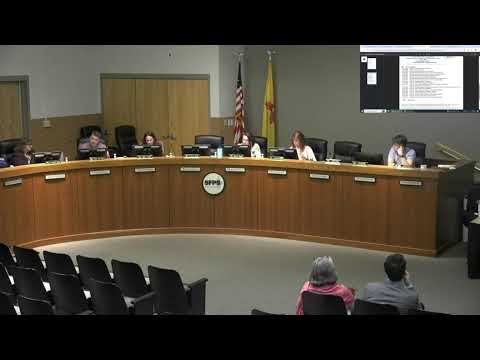
The Santa Fe Public Schools on April 10 reported progress on a districtwide effort to "reimagine" bilingual education, including new professional development, instructional materials, and staffing steps intended to expand dual-language pathways and increase biliteracy.
District leadership said the work stems from a resolution the board passed Jan. 25, 2024, charging staff to build a bilingual-education framework and a communications plan. "Bilingual education can be a wonderful way to not just maintain, but attract families to our district," Deputy Superintendent Vanessa Romero said during the update, which included presentations by Executive Director Daniel Pastrana and members of the Language and Culture team.
The presentation condensed a year of activity into measurable items: a $43,000 investment to produce planning documents that align priority standards for instruction in both English and Spanish; extension of 13 teacher visas for educators from Mexico and Spain using ESSER funds; and a Title III purchase of secondary instructional materials for English-language-development classes. The district also said nearly 200 graduating seniors will receive the New Mexico bilingual seal this year (a 62% increase from last year) and that 159 eighth graders met a bilingual pathway award (an 87% year-over-year increase).
Officials described a multilayered professional-development model that pairs extended training sessions at school sites with classroom modeling, peer observations and a non-evaluative learning-walk protocol. "Our professional development is very interactive and hands on," Holly Call, elementary English learner specialist, said. Call said the district has delivered roughly 18 hours of multi-day training at five schools so far, modeled 20 lessons, facilitated 21 peer-to-peer observations and visited 32 classrooms to collect learning-walk data.
Julia Hoffman, who works with the Language and Culture team, described targeted changes at two elementary schools with enrollment and staffing issues. Sweeney Elementary will phase out an English-only strand and move from an 80/20 to a 50/50 model so incoming kindergarteners receive balanced instruction in Spanish and English. Cesar Chavez will shift to 50/50 as well and take steps to reduce combination-grade classrooms, officials said.
Board members pressed staff on details. "Are there opportunities to prioritize teachers who are from the country of origin of our students?" Board Member Boze asked. Romero said the district uses a vetting process for visa extensions that factors in principal recommendations, classroom observations, interviews and candidates' cultural and linguistic fit with the school community.
Several board members urged caution about using instructional coaches if classroom staffing is short. "My hope is that we're using people who have those skills and talents to be classroom teachers and not instructional coaches," Vice President Noble said. Romero and presenters said the new dual-language instructional-coach role will be school-based and intended to provide weekly modeling and feedback to increase teacher capacity.
District leaders said outreach efforts—bilingual family showcases, podcasts in Spanish, and principal-led registration drives—are producing increased family interest in dual-language strands. "We are excited to see families that were at our showcase coming and saying, 'Yes, I want to choose Salazar,'" Hoffman said.
The update closed with staff committing to continue professional learning cycles, deepen supports for newcomer secondary students, and align bilingual work with curriculum and instruction across departments. Board members asked for continued data on staffing, visa origins and the elimination of combination classes as the district phases these changes.
Staff did not present a formal action item tied to the update; the presentation served as an informational briefing and a prompt for follow-up.