
Commissioners approve exemption to allow minor land division and shared well for Smith property in Livermore area
Get AI-powered insights, summaries, and transcripts
Subscribe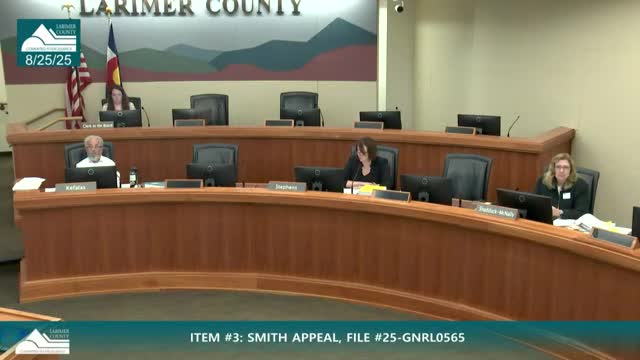
Summary
The Board approved an exemption from subdivision regulations so a 40‑acre parcel at 790 Iger Road can be split and continue using an existing shared well, subject to a recorded well‑sharing agreement, easements and a timeline to file the minor land division.
The Larimer County Board of County Commissioners approved an appeal allowing a minor land division exemption so two existing dwelling units on a 40‑acre parcel in Livermore may be placed on separate parcels while continuing to use an existing exempt well, subject to conditions the board imposed.
The property at 790 Iger Road (parcel 193020032) contains a primary dwelling and a farmstead accessory dwelling unit (ADU) that was approved in 2021 under file 21Zone2990 and governed by a farmstead agreement. The applicant requested an appeal (file 25GNRL0565) to use the minor land division (MLD) process as an exemption from the county’s subdivision regulations so the two dwellings can be recorded on separate lots and, if allowed, continue using the permitted well without triggering stricter Division of Water Resources (DWR) limits that apply to a formal subdivision.
Cassidy Fiore of Larimer County Development Services explained the regulatory tension: the Division of Water Resources had permitted the existing exempt well (permit number 256392) to serve the two dwellings while the parcel remained intact and under the farmstead arrangement, but DWR’s rules are more restrictive if a parcel is processed as a subdivision. Staff found three of five appeal criteria (B, C and D as listed in the land use code) were met but could not make a conclusive determination on the other two criteria. Staff provided a possible approval motion with conditions for the board to consider.
Whitney Coulter, the applicants’ water attorney, told commissioners that DWR’s practical approach is to allow the shared well to continue if the county processes a land division that is not labeled a subdivision. "The Division of Water Resources...said, yes, that's fine as long as the county doesn't call it a subdivision," Coulter said, summarizing the agency’s position and the reason for requesting the exemption. Applicant representatives said their objective is to keep the agricultural operation intact, provide a clear title for the accessory dwelling area for estate planning, and avoid triggering an augmentation plan or other subdivision‑related water requirements.
Under the conditions the board approved, the applicants must: file the minor land division application within one year of the appeal approval; provide a recorded well‑sharing agreement before the minor land division is approved that specifies access, allocation and maintenance for the existing well infrastructure; and record easements necessary for access and maintenance of the well and related infrastructure on both parcels. County staff noted that if the Division of Water Resources later requires separate wells or different allocations, the property owners must comply.
Commissioners said the conditions addressed the most significant public‑interest concerns about long‑term water service, future owners and water rights. Commissioner John Kefalas indicated support after staff and the applicants clarified the conditions and protections for future buyers; Commissioner Jody Shannock McNally and Chair Kristen Stevens also voted to approve the appeal. Commissioner Shannock McNally moved to approve the appeal with the conditions; the motion passed 3‑0.
Why it matters: the decision permits a pathway for family‑owned farmsteads to create separate tax/title parcels for estate planning or family occupancy while avoiding an immediate trigger of Division of Water Resources subdivision restrictions, provided a recorded well‑sharing agreement and easements protect long‑term access and usage. The board’s conditions seek to avoid future disputes by requiring recordation of the legal agreements prior to approval of the minor land division.
Ending: The board approved the Smith appeal (file 25GNRL0565) with conditions; staff will require the well‑sharing agreement and easements before approving the final minor land division filing.