
Residents, Pet Coalition press Waxahachie for more spay/neuter, foster support and clearer enforcement
Get AI-powered insights, summaries, and transcripts
Subscribe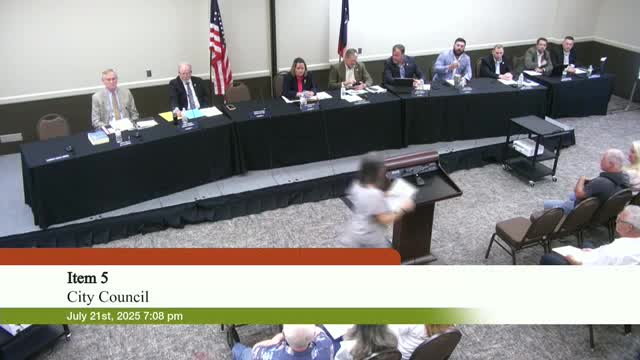
Summary
Multiple residents and the Pet Coalition of Ellis County urged the Waxahachie City Council to expand low-cost veterinary care, formalize foster/surrender procedures, and tighten licensing and anti-dumping enforcement for animals.
Several residents and a representative of the Pet Coalition of Ellis County urged the Waxahachie City Council on Aug. 5 to expand immediate-care options for injured animals, create more foster and surrender pathways, and strengthen enforcement of licensing and anti‑dumping rules.
The appeals came during the public‑comment portion of the council meeting and did not include formal council action. Speakers described ongoing strain on local rescue networks and suggested specific operational changes the city could consider.
Nicole, representative of the Pet Coalition of Ellis County, said the group started in October 2024 and has received 585 requests for help countywide since then. “We began this organization in October 2024. Since then, we’ve received 585 requests for help to date,” Nicole said. She told council volunteers and staff that the coalition has helped place animals, operate low‑cost vaccine clinics, arrange medical care and coordinate with out‑of‑state rescues to find homes. Nicole said the coalition has had 101 people ask for placement help and found placements for 32 animals this year, and has assisted with 133 medical care requests ranging from heartworm treatment to amputations.
Vanessa (resident of 301 Saniska) urged the council to address euthanasia policy and long‑term placement decisions. “If there is a quality of life there, that there would be rescues and fosters in place...and if they can’t step up to the plate at that time, then they would be humanely euthanized,” Vanessa said, calling for a committee to evaluate animals that have been at the shelter three to six months to determine adoptability.
Tiki Smith, who said she serves on the Waxahachie Bridal Services Board, urged quicker access to veterinary care for injured animals and stronger coordination so residents know where to turn. “We need someone who works with the city so that if there’s an injured animal on the side of the road…these animals can get the help that they need,” Smith said.
Tammy (resident of 240 Park Place Boulevard) urged better enforcement of existing licensing rules and stronger penalties for people who dump animals. She said licensing tied to microchipping would speed reunions, and suggested publicizing enforcement actions against dumpers to deter future incidents. “If someone wants to surrender their animal to the shelter, they should have to pay a fee and work at the shelter for several hours to see what goes on in that shelter,” she said as an idea to discourage casual surrenders.
Speakers also requested city partnerships with existing programs. Vanessa and others praised local spay/neuter efforts in the county; Vanessa specifically mentioned Snip It In The Bud and Carolyn Taylor’s recent clinic that spayed and neutered 89 animals in a single day and asked the city to explore cooperating with those providers.
No staff presentation, vote, or formal direction to staff addressing the speakers’ requests was recorded during the public‑comment period. City staff and council members present did not announce new policy changes during the meeting. The public‑comment portion is governed by the Texas Open Meetings Act and council members did not deliberate during that period, as the mayor noted at the start of public comments (Texas Government Code §551.042).
Speakers asked for several specific operational changes the city could consider developing: a low‑cost heartworm prevention program, more vaccine and microchip clinics, formalized foster and surrender pipelines, an on‑call or city‑partnered veterinarian for injured animals, a multi‑member review committee to assess long‑stayed shelter animals, and stepped‑up enforcement and public deterrence against dumping. Petitioners said the Pet Coalition is offering to partner on vaccine clinics, microchipping and shelter pet exposure efforts.
Council members did not vote on any of the requests during the meeting. The comments were recorded as part of public input; any follow‑up proposals, funding requests or ordinance changes would require separate agenda items and formal council action.
The public comment included detailed operational and numerical claims about volunteer capacity, numbers of animals served by the coalition and recent clinic results; those figures were given by speakers at the meeting and are reported here as stated.