Get Full Government Meeting Transcripts, Videos, & Alerts Forever!
Get email alerts on the Late Night Alcohol Sales topic
No spam. Unsubscribe anytime.
Fredericksburg council opens public debate on limiting late-night alcohol sales; forms group to pursue targeted solutions
Summary
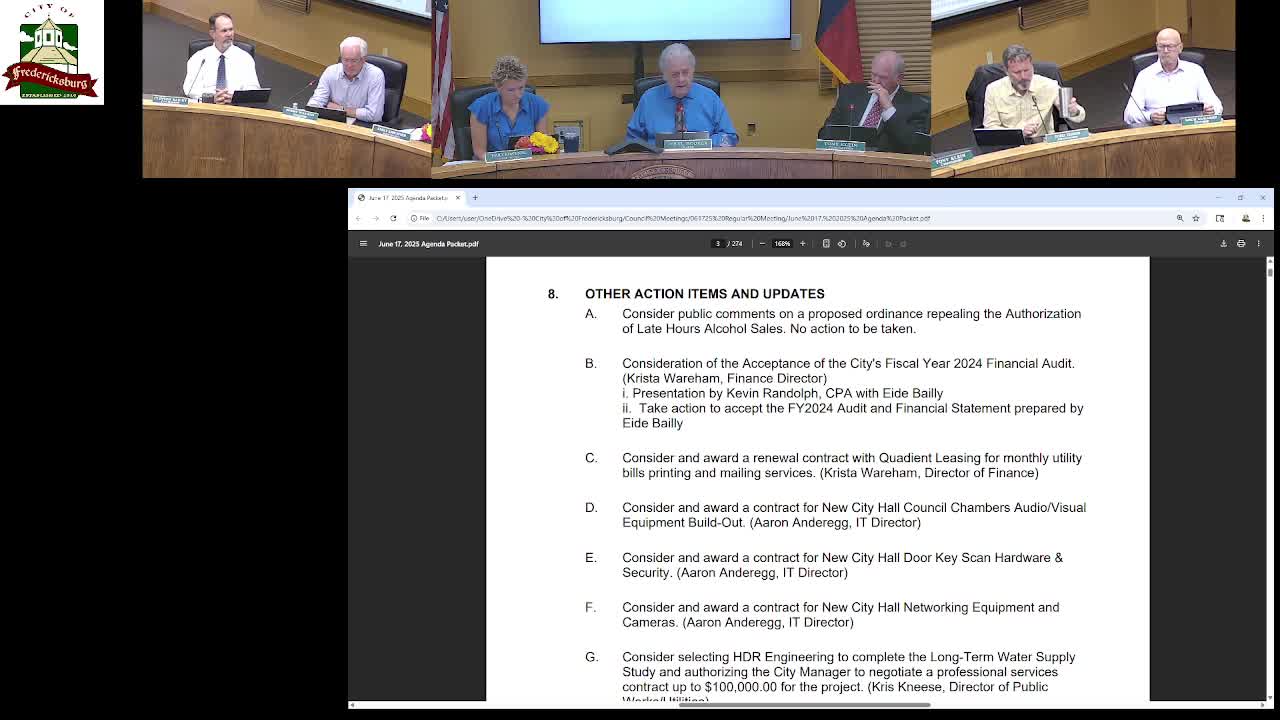
City council opened a public hearing on a proposed ordinance to repeal authorization for after-midnight alcohol sales, heard roughly 35 written and dozens of in-person comments, and agreed to continue the discussion with a small group including hospitality representatives and public safety officials.
The Fredericksburg City Council opened a public hearing on a proposed ordinance to repeal authorization for late-night alcohol sales and heard extensive public comment on whether a blanket hour restriction would reduce public intoxication and impaired driving.
Council members said they received about 35 speaker cards, numerous emails and a 15-page petition opposing a midnight cut-off, and invited focused, pragmatic suggestions. Mayor (unnamed in transcript) summarized the main themes and asked speakers to avoid repeating points already submitted in writing.
The hearing drew business owners, bartenders and residents. Several hospitality operators said cutting service at midnight would cost servers and small businesses and would push drinking into unstaffed locations. Kelly Welch, business owner of Western Edge, asked, “What is it trying to solve? What does that solve?” and urged careful study of targeted enforcement instead of a blanket rule.
Other speakers urged the council to prioritize public safety and to consider whether Fredericksburg’s late-night culture is the community they want. Resident Rosemary Essinson said, “I don’t think anything good happens after 12:00,” and described instances where patrons were overserved and left in unsafe condition.
Chief of Police (unnamed in transcript) provided departmental data showing that about 41% of DWI arrests and about 32% of public-intoxication arrests during a recent 2½‑year period occurred after 1 a.m. He said reduced call volume late at night gives officers more time for proactive enforcement and that the department conducts late-night walkthroughs and parking-lot checks when staffing allows.
Council did not vote on an ordinance. Instead members said they would continue the conversation and explore targeted approaches: intensified enforcement, better coordination with the Texas Alcoholic Beverage Commission, voluntary industry measures and a stakeholder working group. Several council members and members of the hospitality community volunteered to participate.
The council asked staff and the police to collect and publish relevant metrics and to work with hospitality and state enforcement agencies on practical options. No ordinance was adopted at the meeting; the city committed to further study and stakeholder talks before any formal changes.
Ending: Council indicated both the business community’s concerns about livelihoods and residents’ public-safety worries will shape the next steps. The council’s direction was procedural: continue fact-finding and convene a stakeholder group to craft targeted, enforceable options rather than immediately adopting a blanket hour restriction.