
Fredericksburg council holds public hearings on proposed tax increase and budget, postpones final votes to Sept.16
Get AI-powered insights, summaries, and transcripts
Subscribe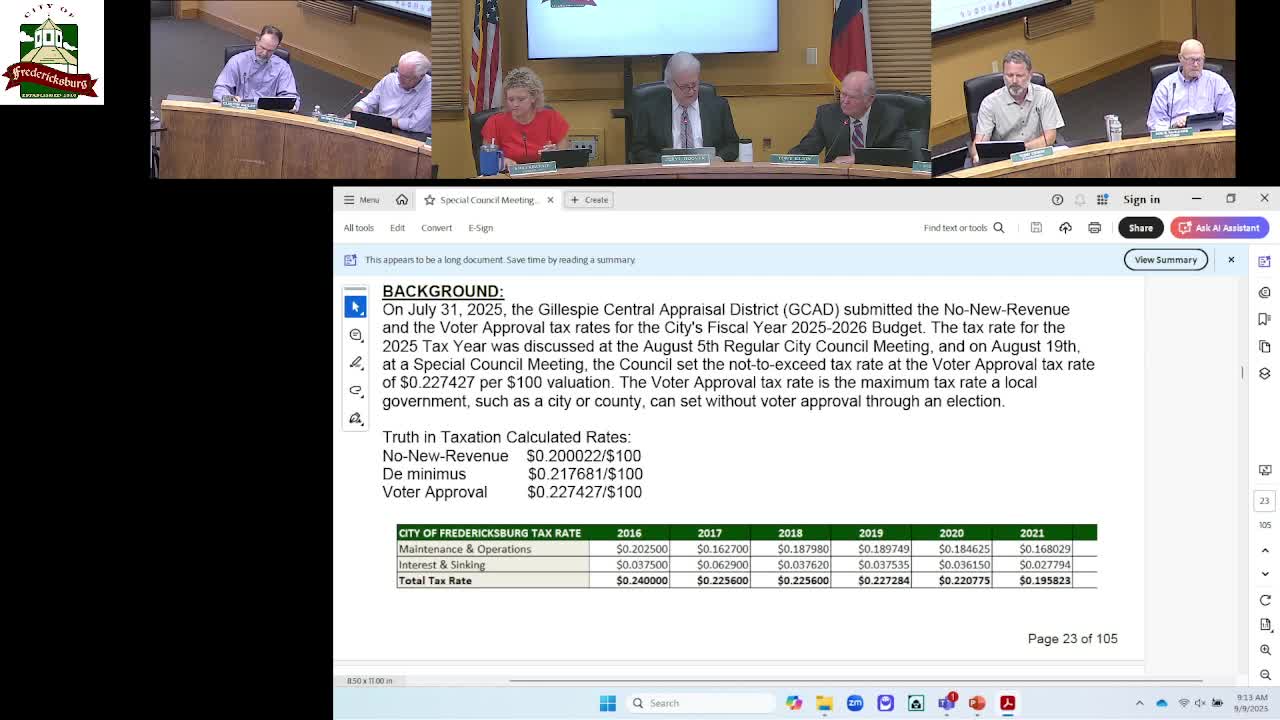
Summary
After a public hearing on a proposed tax increase and a separate hearing on the fiscal 2026 budget, Fredericksburg city council voted to postpone final adoption of both the tax rate and the budget until the council's Sept.16 meeting following public comment and staff presentation.
The Fredericksburg City Council opened public hearings Sept. 9 on a proposed tax increase for the 2025 tax year and on the proposed fiscal 2026 city budget, then voted to postpone final adoption of both items to the council's Sept. 16 meeting.
Finance Director Krista Wareham briefed the council on the three technical tax-rate calculations supplied by the appraisal district, noting the voter-approval tax rate, the no-new-revenue rate and the de minimis rate. "The voter approval tax rate is the maximum tax rate a local government such as a city or county can set without voter approval through an election," Wareham told the council, and she read the rates provided by the appraisal office: the no-new-revenue rate 0.200022, the voter-approval rate 0.227427 and the de minimis 0.217681.
The nut graf: the hearings were informational and required by law; after public comment the council delayed final action to allow further consideration. Council members said they wanted more time to consider public input on new charges and long-term maintenance obligations tied to capital projects.
During public comment, residents raised concerns about long-term operating costs and new user fees. Annette Bennett urged the council to evaluate long-term maintenance obligations for public–private projects, saying those obligations could "obligate future councils with maintenance and benefits expenses in the hundreds of thousands of dollars that will be incurred each and every following year." Randy Briley estimated the voter-approval rate would yield about $1 million in net new revenue and said that recurring costs to continue operations were "about $500,000," adding he supported using the voter-approval rate but cautioned against new user fees that shift existing general-taxed services onto a narrower base.
Other speakers urged the city to study contracting options as a cost-control measure. Charles Schmidt, a longtime municipal manager, suggested using salary savings from vacant positions and targeted contracting as one of several cost-control tools. City staff and council discussed prior analyses of contracting for sanitation and street maintenance; staff said outsourcing some services had been more expensive than doing the work in-house and noted the customer-service role some in-house crews provide.
The council then took the required procedural action: a motion to postpone final adoption of the tax rate until Tuesday, Sept.16, carried by voice vote. Later the council took the same procedural motion to postpone final adoption of the fiscal 2026 budget until Sept.16. Both motions passed without recorded opposition.
The city filed the proposed budget on Aug. 15 and made a hard copy and an online copy available. Wareham said the proposed citywide expenses as presented were effectively flat year over year but that personnel costs — especially police and fire — remain a significant portion of the general fund. The council formally closed both public hearings and scheduled final votes for Sept.16.