
District staff outline $400M-plus facilities backlog, present life-safety bond and sales-tax funding options
Get AI-powered insights, summaries, and transcripts
Subscribe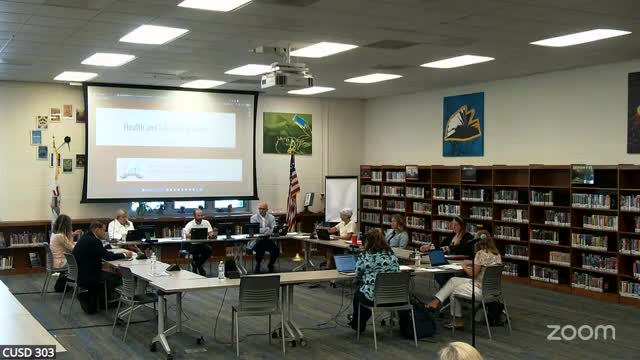
Summary
The CUSD 303 Business Services Committee revisited the district’s long‑term capital needs July 28 and discussed life‑safety bonds, county facility sales tax and other financing options after staff reported more than $400 million of identified building needs and $38 million of investments since 2021.
The CUSD 303 Business Services Committee revisited the district’s long‑term capital plan July 28 as staff and external advisors outlined the scope of building needs, how past spending has been used and financing options to address remaining work. District CFO Jennifer Porter opened the presentation and said the meeting’s goal was to develop “a shared understanding of the scope of our needs, what we've accomplished, and tools available…to move forward.”
Amanda, a district facilities presenter, summarized the district’s assessments and prior work. “Since 2021, we've invested $38,000,000, but over 400,000,000 is identified that needs is remaining,” she said, describing a facility assessment by Wold Architects, a citizen advisory council review and prior safety and access projects.
Why it matters: district staff said deferred maintenance and aging systems will raise long‑term costs if left unaddressed. The presentation laid out financing choices — non‑referendum bonds tied to the district’s debt service extension base (DSEB), newly available life‑safety bonds authorized under Public Act 103‑0591, debt certificates or alternate bonds repaid from operating funds, traditional voter referendum bonds, and a county school facility sales tax — with sample cost and homeowner tax impacts for each.
Key details and options - Scope and priorities: staff presented a five‑year capital plan that allocates about $32 million and reported the plan is roughly 77% for replacement/maintenance and 23% for programmatic improvements including gym/community room air conditioning. The facility assessment (prepared by Wold Architects) and the citizen advisory council produced overlapping lists of needs, including roofs, parking lots and mechanical systems. - Estimated backlog: staff cited more than $400 million of identified needs (the presentation noted overlap among sources and that the facility assessment was a 10‑year outlook completed in 2021–22). - Life‑safety bonds (Public Act 103‑0591): Elizabeth Hennessy, managing director and head of the Midwest public finance team at Raymond James, summarized the new state law that allows issuance of life‑safety (fire‑prevention and safety) bonds without a referendum. She said life‑safety bonds can fund replacement of boilers, unit ventilators, fire alarms, doors and similar items but “does not provide air conditioning for buildings that do not currently have AC.” Hennessy noted some districts have used life‑safety amendments to fund building replacements in rare cases and described the approval process through the regional office of education (ROE) and the Illinois State Board of Education (ISBE). - Sample issuance and taxpayer impact: Raymond James gave a sample scenario of $40 million in life‑safety bonds. Under a 10‑year repayment assumption at a roughly 4.10% interest rate (plus a 25‑basis‑point cushion) the presentation showed an estimated tax impact of 12.8¢ and an annual payment near $5 million; Raymond James translated that to roughly $118 per year on a $300,000 home for 10 years in the example. The consultant emphasized longer repayment terms lower annual payments but increase total interest costs. - Other borrowing tools: staff and the advisors reviewed non‑referendum working‑cash / funding bonds tied to the district’s debt service extension base (DSEB), which is constrained because the district has two existing issues using most of that capacity; alternate bonds and debt certificates paid from operating funds; and traditional referendum bonds that require voter approval but can address a broader set of projects. - County school facility sales tax: Hennessy described the county school facility sales tax (enacted in 2007 and amended since) as an alternative that does not increase property taxes and can be used for facilities and, if framed in the ballot language, for school resource officers and mental‑health professionals. She said a 1.00% county levy would roughly generate $9 million per year for District 303 under current estimates, and noted that the sales tax requires a county‑wide ballot process with approval by districts representing a majority of county enrollment.
Board questions and next steps Board members asked how much of the district’s backlog would qualify for life‑safety funding; Amanda said she did not have a precise percentage and recommended a detailed follow‑up to inventory which items would be eligible. Board member George Lackner asked for an estimate of how much of the capital backlog would qualify under life‑safety rules; staff agreed to return with that analysis. Several board members asked staff to prepare two complementary scenarios: (1) the fiscal and operational consequences if the board takes no action and (2) packages showing what could be accomplished using life‑safety bonds, versus a voter referendum, versus other mixes of funding.
Administration said it will bring back a more detailed inventory of assets (roofs, mechanical systems, deferred maintenance counts and ages), a clearer estimate of life‑safety‑eligible items and dollar estimates for different financing approaches, likely in September. No formal action or vote was requested or taken at the committee meeting; the discussion was informational and the committee requested additional analysis.
Attribution: quotes and attributions in this article come directly from committee presenters and consultants at the July 28 Business Services Committee meeting.