
Springfield District 186 presents tentative FY26 budget showing $17.9 million deficit; public hearing set Sept. 15
Get AI-powered insights, summaries, and transcripts
Subscribe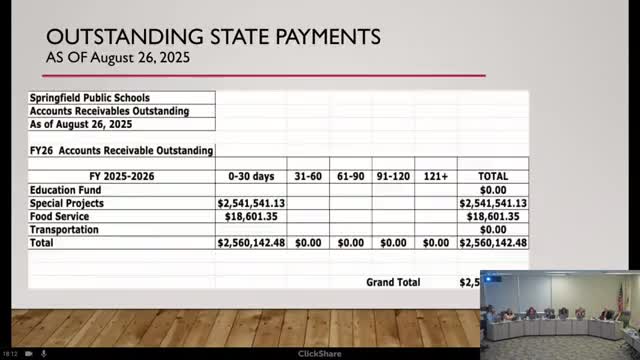
Summary
District 186 officials on Sept. 2 presented a tentative fiscal 2026 budget that projects $236 million in revenues, $253 million in expenditures and a $17.9 million operating deficit; board members debated potential reductions including program cuts and school consolidation and scheduled a public hearing for Sept. 15.
The Springfield Public Schools District 186 Board of Education received a presentation on Sept. 2 of the district’s tentative fiscal 2026 budget, which projects $236,000,000 in revenues against $253,000,000 in expenditures, producing a $17,900,000 operating deficit. The presentation was provided as information only; the board scheduled a public hearing and vote on the budget for the regular board meeting on Sept. 15.
Why it matters: The deficit would reduce operating fund balances and lower the district’s days of cash on hand to about 36 days (roughly 10 percent), below the board policy target of 15 percent. Board members and staff said the gap requires a deficit-reduction plan and short- and medium-term decisions affecting programs, staffing and capital choices.
Mr. Miller, a business-office staff member who presented the financial slides, told the board the district is budgeting conservatively—expenditures at 100 percent of projected costs and revenues at lower-end projections—and that the district expects to spend the full budget this year rather than the historical ~95 percent. “With these numbers this means the district will be operating at a $17,900,000 deficit in FY26,” he said. He described projected fund balances by fund: the Education (Ed) Fund shows a projected deficit of about $15,500,000 and an ending Ed Fund balance of approximately $4,100,000; the Operations & Maintenance (O&M) Fund shows a $333,000 deficit; transportation shows a roughly $2,000,000 deficit; the tort fund is projected to be down about $657,000 while IMRF (retirement) is expected to show a small surplus.
Board members pressed staff on the main drivers: the end of ESSER (federal) relief funding, annual increases in salaries and benefits still under negotiation, lower state reimbursements for mandated programs and inflation on goods and services. Mr. Miller explained transportation reimbursement (a mandated categorical) will be prorated by the state for FY26 at an estimated 71 percent for regular education and 60 percent for special education, down roughly 10 percentage points from the prior year, which he said represents nearly a $1,000,000 swing for the district.
Superintendent Gill said the administration has prepared a three-year deficit reduction plan that assumes modest local growth, some EBF (Evidence-Based Funding) increases, and one-time adjustments; the plan calls for an initial 5 percent reduction across many line items and larger adjustments where necessary. “We went pretty hard into this so we could reduce as much down in the first year because we’re looking at that lower fund balance that we really have to address,” she said.
Debate and possible actions: Several board members urged the administration to consider a wide range of options, from smaller operational cuts and fee adjustments to larger structural changes. One board member proposed bringing “all options to the table,” including potential school consolidations or changes to the district-run SCOPE summer/extended-learning program, which board discussion identified as having carried a deficit historically. Dr. Jordan, who oversees SCOPE operations, said enrollment had improved this summer and the program team is working to hire staff and finalize summer revenues; he expected final numbers the following day.
Staff noted potential offsets and one-time revenues: modest CPPRT (home-rule sales-tax replacement) increases, solar energy savings at Lanphier High School (about $10,000 per month so far), potential state and federal rebates related to solar projects (estimated roughly $1.1 million rebate on a $1.4 million project) and the possibility of selling surplus West Side property as a one-time infusion of cash (with uncertain timing and tax-base impacts). Mr. Miller also reviewed bond payment schedules and said the district has enough in the capital savings account to meet the December bond payment but must preserve other resources for the year.
Next steps: The district will hold a public hearing on the tentative budget at the board’s Sept. 15 meeting and will return to the board with an amended budget in the spring reflecting negotiated salary settlements, reconciled revenues, and refined projections. The administration said it will pursue immediate operational savings the board can approve in the coming weeks and continue to develop the three-year deficit reduction plan.
The presentation and the board’s discussion made clear the district is confronting a combination of unknown future state and federal funding levels, rising costs and the end of pandemic-era federal supports, requiring both short-term belt-tightening and longer-term structural decisions.