
Boulder County Housing Authority presents 2026 annual plan and MTW supplement; changes include longer voucher search windows and streamlined utility tables
Get AI-powered insights, summaries, and transcripts
Subscribe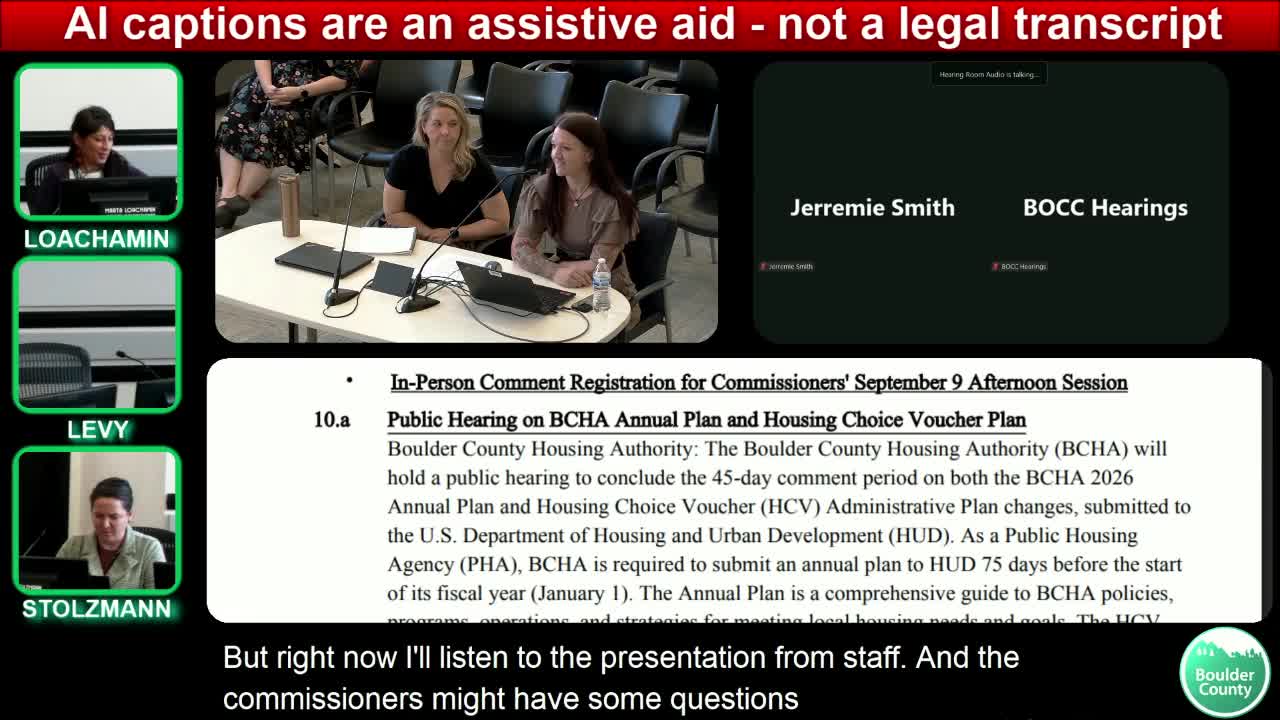
Summary
BCHA staff presented the 2026 annual plan, administrative plan revisions driven by HOPMA, and a Moving to Work supplement proposing streamlined utility allowances, extended voucher search periods and deferred medical‑deduction software changes until 2027; commissioners approved both hearings to proceed.
Boulder County Housing Authority staff on Tuesday closed public comment on their 2026 annual plan, administrative plan revisions and the agency’s Moving to Work (MTW) supplement, and commissioners voted to approve the plans as presented for submission and further action.
Kelly Keefe, housing choice voucher program manager, told the board the package included the agency annual plan, a Moving to Work supplement, and a revised Housing Choice Voucher Administrative Plan that incorporated changes required by the Housing Opportunity Through Modernization Act (HOPMA). Keefe described outreach and resident engagement efforts on the plans, saying the draft plans were posted since July, copies were available at office locations, and staff mailed and emailed notices to voucher holders and tenants.
Keefe provided outreach numbers: 1,390 emails to voucher holders/tenants with email addresses, 476 emails via the new ReachWell communications app plus 281 push notifications, and 1,855 text messages. Staff held four resident feedback meetings (one evening session in Longmont; three daytime sessions at Josephine Commons in Lafayette, Kestrel in Louisville and Willoughby Corner in Lafayette). Keefe said 20 people attended those meetings and staff issued eight $25 gift cards as meeting raffles.
The administrative plan updates respond to HOPMA-required changes that affect income and asset calculations, student status rules, and other determinations. Keefe said one tenant-facing change standardizes voucher-searching timelines: new voucher holders will receive 120 days initially to find housing and an automatic 90-day extension on request; further extensions would require reasonable-accommodation documentation and are subject to funding availability. Keefe said the change took effect for households beginning Aug. 1.
Keefe described several other administrative updates: expanded definitions of gender for bedroom assignments, a clarification allowing staff to request photo or video proof when additional bedrooms are requested as reasonable accommodations, revised treatment of alimony and child-support income, procedures for minors turning 18 mid‑recertification, a new staff conflict-of-interest policy, and adjustments to repayment terms.
On MTW activities, Keefe said the agency had focused in year one on small, testable changes and would continue incrementally. Proposed MTW flexibilities include streamlining utility allowances to two tables (based on bedrooms and whether occupants pay some or all utilities) rather than the current multi-table system that varies by building type and fuel source; the change is intended to simplify voucher shopping and reduce administrative burdens. Keefe said those streamlined utility allowances were expected to take effect Jan. 1, 2026 if HUD and county approvals proceed.
Keefe said another MTW goal was to expand project-based voucher (PBV) flexibility beyond current federal caps, and to explore allowing BCHA staff to perform unit inspections (now done by third-party contractors) for BCHA‑owned units under MTW authority. The agency also plans to study extending the minimum occupancy period before a PBV household may request a tenant-based voucher (BCHA staff proposed studying 24 months, compared with the current 12-month standard).
Keefe said a planned change to simplify medical‑expense deductions (reducing collection of monthly receipts and moving to a calculation that would not require receipts) remains on hold because the agency’s software vendor could not deploy the needed features; she said the agency expects to pursue that change in 2027 after identifying a vendor solution. Keefe summarized: the utility allowance changes will go forward in 2026 if approved; the medical-deduction automation is deferred to 2027.
Keefe described other resident-focused steps: increased tenant check-ins at 60 days into voucher-searching periods, offers of rental-search assistance, and continued ability for participants to submit medical receipts through the existing process until automated changes are available.
Commissioners had no substantive public comment in person; one virtual commenter listed on the sign-in did not join. The board voted to approve item 10a (annual plan and voucher administrative plan) and item 10b (MTW supplement) as presented; Keefe said she would return in 1–2 weeks with a resolution to sign for HUD submission. Keefe noted the final plan materials must be submitted to HUD 75 days before the start of the agency’s fiscal year (the staff deadline cited was Oct. 18).