
Residents and small-business owners urge Boulder County to pause proposed unincorporated minimum-wage increase
Get AI-powered insights, summaries, and transcripts
Subscribe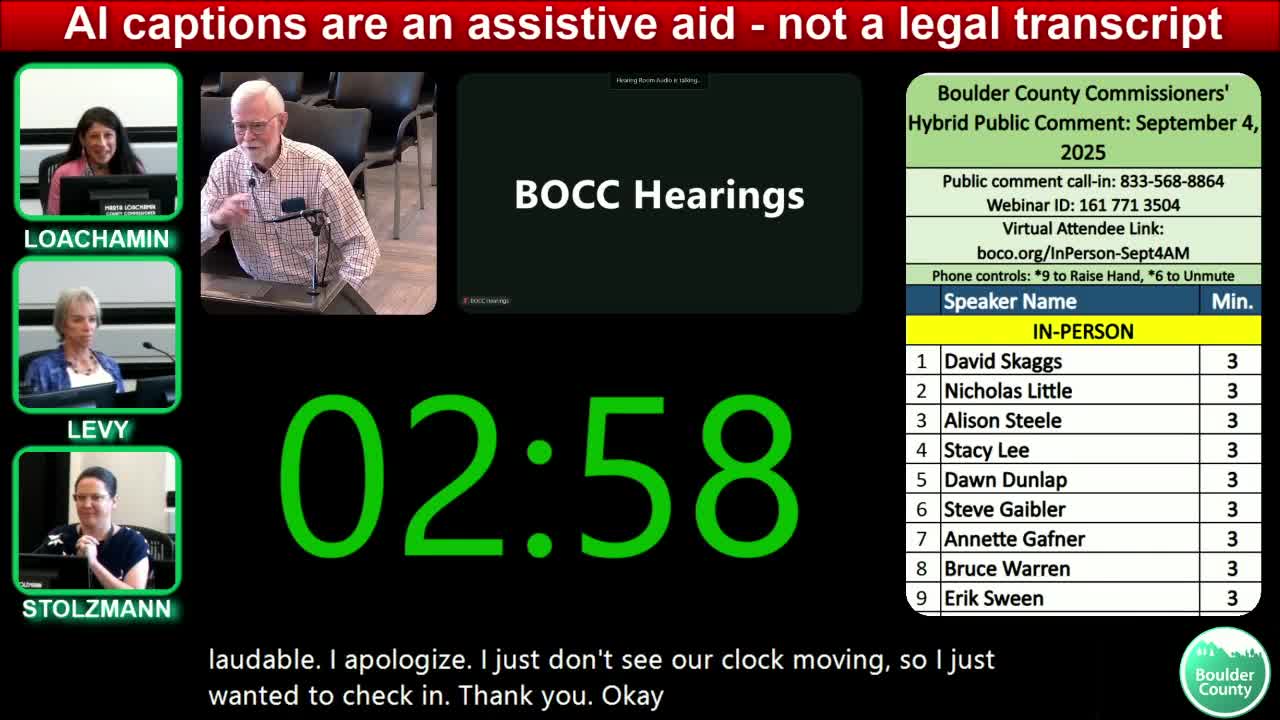
Summary
At a Sept. 4 public comment session, residents and business owners urged the Boulder County Board of County Commissioners to pause or reconsider a plan that would raise the minimum wage for the county’s unincorporated areas, saying the change would harm small towns, farms and teen employment.
BOULDER, Colo. — At a Sept. 4 public comment session, residents and business owners urged the Boulder County Board of County Commissioners to pause or reconsider a plan that would raise the minimum wage for the county’s unincorporated areas, saying the change would harm small towns, farms and teen employment. The speakers said the county’s schedule for minimum-wage escalation treats a legal minimum as a living wage and that applying a higher wage only in unincorporated parts of the county creates an uneven playing field with neighboring municipalities and chains. “The county is equating minimum wage with living wage,” said a public commenter who opened the session, citing a living-wage estimate of about $26 an hour and roughly $54,000 per year. The speaker warned that using minimum-wage policy to achieve a living wage could drive up costs and inflation. “Many of them have been coming to see us for more than 25 years,” Dawn, a server at the Garden Gate Cafe in Niwot, told commissioners. “I make good money at my job with tips consistently earned between $35 and $50 per hour. I don't need a higher minimum wage. What I do need is for my job and my restaurant to survive.” Steve Gabler, owner of the Garden Gate Cafe, said he attended a business meeting in Longmont where employers presented concerns about higher labor costs and that he was “appalled” at what he called lack of attention from some advocates. “I found that disgusting,” Gabler said of behaviors he observed at that meeting. Jay French, co-owner of Hygiene Feed and Mercantile in Hygiene, said his farm- and agriculture‑support business already faces competition from businesses in adjacent jurisdictions that would not be subject to higher unincorporated-area wages. “We’re paying more than other areas around us,” French said. “This is putting an undue burden on us as far as our payroll is concerned.” Paul Rabb, a resident of unincorporated Boulder County, told the commissioners the policy is “unfair because it imposes a substantial cost on certain businesses simply by virtue of where they’re located” and warned of higher teen unemployment and shuttered storefronts. Bruce Warren, an attorney and former county planning commissioner, urged commissioners to consider the statute that authorized county-level minimum-wage action and its emphasis on regional approaches and intergovernmental agreements. Warren also noted the statute allows different treatment for unemancipated minors and suggested the county consider a separate approach for high‑school students. Commissioner Marta Levy responded to public comment and clarified that the board recognizes the difference between a living wage and a minimum wage. She said the county has scheduled a public discussion of the issue for Sept. 9 at 10:30 a.m. and that commissioners will continue to gather information. “I agree with your analysis that living wage and minimum wage are very different concepts,” Levy said. Discussion vs. decision: Speakers offered examples, economic arguments and personal testimony; commissioners gave no formal vote or policy change at the Sept. 4 meeting. The board scheduled further discussion at a Sept. 9 public meeting; no motion or ordinance adoption occurred on Sept. 4. Why this matters: The debate concerns whether a county-only minimum-wage increase will disadvantage small, locally owned businesses and farms in unincorporated towns such as Niwot, Hygiene and other rural corners of Boulder County, and whether higher localized minimums will affect teen hiring and apprenticeship opportunities. What’s next: The county’s discussion of the unincorporated-area minimum wage is scheduled for Sept. 9 at 10:30 a.m. for additional public input and commissioner deliberation.