
The Dalles reviews updated economic-opportunities analysis; consultants report 202 net buildable employment acres, warn of site-size shortfalls
Get AI-powered insights, summaries, and transcripts
Subscribe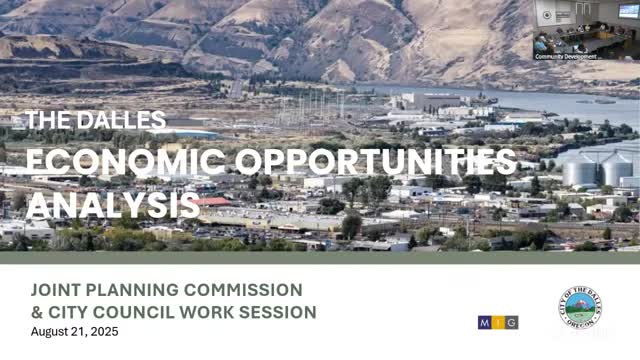
Summary
Consultants and city staff presented an updated Economic Opportunities Analysis (EOA) and a refined Buildable Lands Inventory (BLI) at a joint City Council and Planning Commission session in The Dalles where they reported an estimated 254 gross acres of vacant or partially vacant employment land and about 202 net buildable acres after accounting for existing development and infrastructure set‑asides.
Consultants and city staff presented an updated Economic Opportunities Analysis (EOA) and a refined Buildable Lands Inventory (BLI) at a joint City Council and Planning Commission session in The Dalles where they reported an estimated 254 gross acres of vacant or partially vacant employment land and about 202 net buildable acres after accounting for existing development and infrastructure set‑asides.
Joshua Chandler, Community Development Department staff, told the council the city began the update “beginning this last spring” and that the EOA will support proposed comprehensive-plan text changes and potential adoption steps. Matt Hasty of MIG, the consultant team lead, said the project updates employment forecasts, revises the BLI and proposes reorganized goals, policies and implementation measures for the comprehensive plan.
The consultants described three employment-growth scenarios. Mary Anne (consultant) said local employment has recovered since 2020 and “the growth rate since 2020 has been 1.2%,” while the Oregon Employment Department forecast for the larger region projects slower growth. Arianne Colombo explained the scenarios translate into different land needs: the state forecast scenario produced the lowest demand, a population/labor-force scenario was mid‑range, and a target‑industry scenario—focused on manufacturing, natural resources and construction—produced the highest land demand.
Jessa Miller, MIG, summarized the refined inventory: “There is an estimated 254 gross acres of vacant or partially vacant employment land in The Dalles,” she said, and after removing constraints such as wetlands, stream buffers, steep slopes, easements and space set aside for streets and infrastructure, the team calculated roughly 202 net acres available for employment development.
Why the totals may not meet future needs
Although the aggregate acreage approaches some demand estimates, consultants and councilors emphasized a mismatch between aggregate supply and the configuration of available sites. The inventory shows many small sites (0–2 acres) and few medium (8–60 acres) or large (over 60 acres) vacant parcels. MIG’s site-size analysis estimates that most future employers will need small parcels, but medium and large firms—while fewer in number—account for a large share of total employment and often require larger or expandable parcels.
The consultants also noted the inventory counts some large parcels owned by private firms—most prominently Google—because state rules treat undeveloped land as buildable capacity even if a single private owner currently controls it. Matt Hasty said state rules limit when planners can exclude vacant land from the inventory and that “we can say … in the next five years, they are not considered available,” but the parcels remain part of the 20‑year inventory unless deed restrictions or other statutory exclusions apply.
Councilors pressed the team on how Google‑owned lands affect the usable supply. Staff said the analysis applied a lower employment‑density assumption to Google properties (a discount of about 45 acres in the capacity calculations) to reflect those sites’ lower jobs‑per‑acre profile, but noted the parcels remain in the inventory under state methodology.
State and regional context
Councilors and staff discussed the Columbia River Gorge Commission and the Department of Land Conservation and Development (DLCD) as external actors whose rules and interpretations affect urban growth boundary (UGB) expansion decisions. Several councilors said the Gorge Commission previously used the availability of parcels across the river at Dallesport to argue the city did not need a UGB expansion; staff and consultants said the draft EOA should be written to be clear about what land is practically available to The Dalles.
Comprehensive-plan updates and recommended policies
Consultants described a proposed reorganization of the city’s economic chapter into seven goals with associated policies and implementation measures—examples include policies to “protect and plan for long‑term industrial supply,” streamline permitting and offer predevelopment assistance for catalytic sites, and add explicit recognition of health care and education as economic sectors. Staff said many of these policy and implementation items were drafted by city economic development staff and that council and planning commissioners should review, revise and make them their own before an adoption process.
Public‑process timeline and next steps
City staff said they will incorporate advisory‑committee and council feedback and bring updated materials back for a public adoption process. The team proposed a deadline for council comments so staff could prepare a 35‑day public notice and begin the formal adoption hearings: additional written comments are requested by September 4; staff said a first public hearing would likely occur in October after the required notice period. The meeting closed with direction to circulate the revised documents and the presentation to the council and planning commission for review.
Action taken
At the start of the session the council approved the meeting agenda by voice vote after a motion to approve was made; no further formal votes were taken on the EOA materials during the presentation.
What’s next
Staff and MIG will revise the draft BLI memo and the EOA narrative to incorporate feedback (including a clearer description of which parcels are practically available in the short term), make site‑level adjustments noted by advisory committee members, and circulate a revised packet to the planning commission and council ahead of the public adoption hearings.