
City details long-delayed First Street reconstruction, estimates $6.9 million cost and yearlong construction
Get AI-powered insights, summaries, and transcripts
Subscribe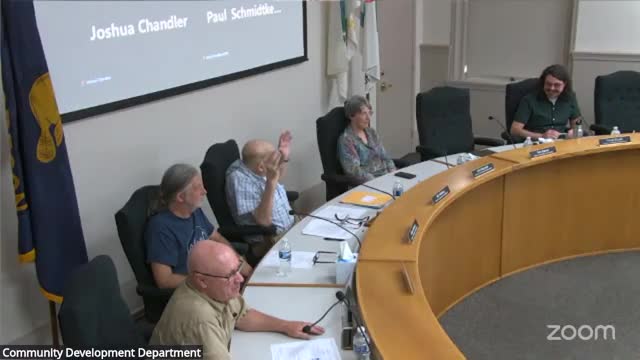
Summary
City staff told the Historic Landmark Commission the First Street Project will replace failing sidewalks and retaining walls, address an undersized water line and archaeological concerns, and likely close First Street for about a year; bid award is planned this fall and easement acquisitions are complete.
City community development staff presented the long-delayed First Street Project, saying the city expects roughly $6.9 million in total construction costs and hopes to begin work in winter or spring of next year.
The project matters because it will replace failing retaining walls and sections of sidewalk — including hollow sidewalks and a vaulted area at the Baldwin Saloon — and upsizes a historic water main that staff said dates to the 1870s. The work also touches archaeologically sensitive areas and will require mitigation steps agreed with the state review office now under review.
Josh, the city’s community development staffer leading the presentation, said, “This project’s been around for quite a long time. We’re getting closer to it actually happening.” He told the commission that easement acquisitions needed to construct walls and access property were completed this week and that the city expects final construction documents shortly. The city expects to advertise bids this fall and said its goal is to award a contract by year’s end.
Staff provided engineering detail on the most fragile stretches of First Street: sinking sidewalks caused by corroded support members and failing walls beneath the walk at multiple blocks, and a vaulted sidewalk area in front of the Baldwin Saloon that staff said will be rebuilt as an elevated span supported on driven piers to avoid imposing new loads on the adjacent building foundation. Paul Schmicki, the project engineer, joined the presentation and answered technical questions.
Staff described mitigation measures for historic and archaeological impacts. They said a 2021 structural analysis recommended removing the existing walls; the project design calls for gabion (wire-basket) retaining walls with a basalt-facing at the visible front, interpretive signage and optional QR-code material about Chinatown, and stamping the Chinese name for The Dalles in several sidewalk locations. Staff said they submitted a memorandum of agreement to Shippo (the state historic preservation review office listed in transcript as “Shippo”) and that the memorandum is under review.
Budget and funding: staff gave a subtotal construction estimate of about $6,000,000 and said additional line items bring the current estimate to $6,920,000. The city reported approximately $3,500,000 budgeted in Fund 18 and $3,200,000 from the Urban Renewal Agency; staff said about $1,500,000 has been spent to date on planning and design. The presentation noted a recurring 5% annual increase in project costs. Josh also said the city earlier terminated a long-running agreement with ODOT, which staff said saved roughly $820,000 after accounting for $320,000 of grant expenditures returned or reconciled.
Staff said the construction would likely require closing First Street for the life of the project. They said they are coordinating with businesses, the Chamber and Pacific Coast Producers and that the Federal Street Plaza project will overlap in schedule (Federal Street Plaza timed for spring–fall next year). Staff announced a public open house in October and said the First Street construction contract, once awarded, is expected to take about a year.
Commissioners and members of the public pressed staff on the design: Commissioner Victor Johnson asked whether the new bike lane would be physically separated; staff and the engineer said the plan currently shows striping but not vertical separation. Commissioner Eric Gleason and other commissioners expressed concerns about removing the original stone walls and about whether gabion baskets meet historic-preservation standards; Gleason said the walls are “contributing elements to the National Register Historic District” and added, “I’m just kind of sad to see those walls go.” Josh responded that the project team tried multiple approaches, that geotechnical analyses limited options for simply filling voids, and that salvaged stone could be reused or made available for reuse, donation or auction.
Staff emphasized safety and blight reduction as project drivers. They said sections of sidewalk are settling dramatically — in one photo the curb and sidewalk were nearly flush with the street — and that failing walls present tripping and structural hazards. They reiterated that archaeological zones border the project and that mitigation steps will be taken per the memorandum with Shippo.
The commission did not take a formal vote on the project at the meeting. Staff invited further comments and said they will follow up on questions raised about bike-lane protection, basalt stone salvage and the final mitigation language once Shippo responds.
Ending: Staff asked the commission to share comments before final documents are issued and reminded commissioners of the October open house and the project timing that aims for construction next winter or spring with an approximately one-year construction window.