
Boulder County commissioners refer 0.15% sales tax for behavioral health to voters after debate on priorities and oversight
Get AI-powered insights, summaries, and transcripts
Subscribe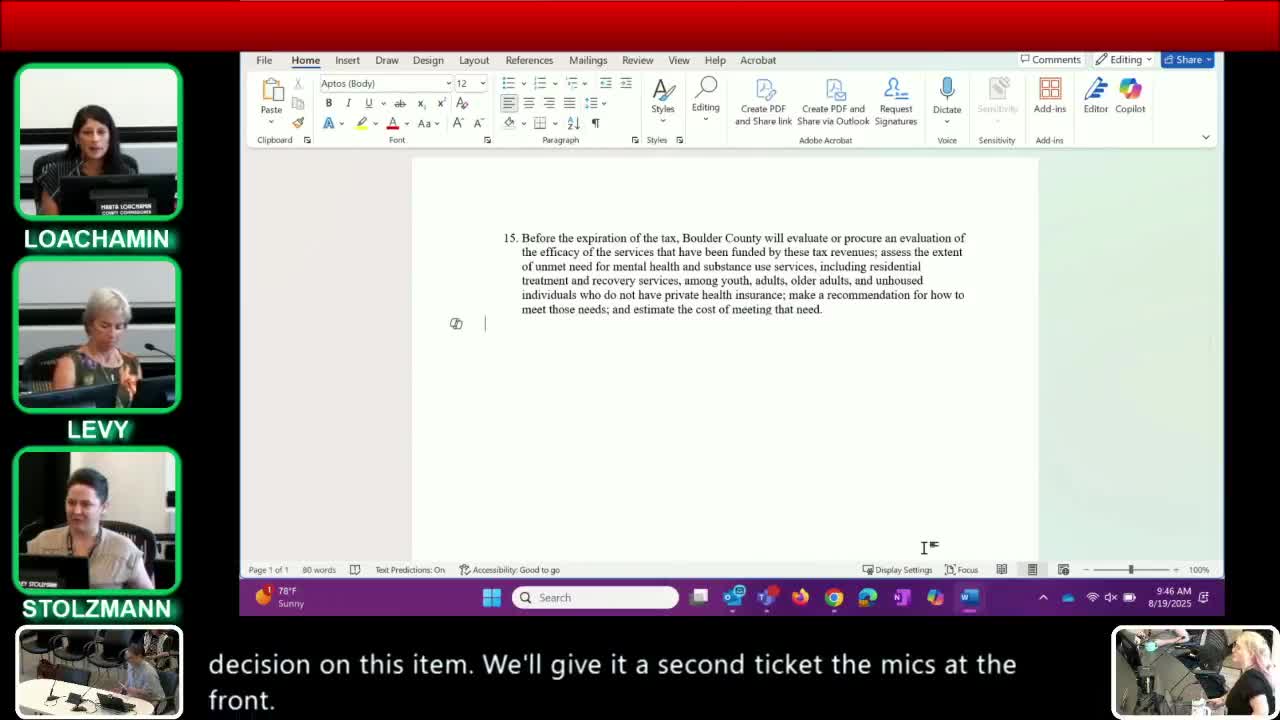
Summary
After public testimony and detailed staff discussion about program priorities, funding mechanics and oversight, the Boulder County Board of County Commissioners voted to place a proposed 0.15% sales and use tax for behavioral health on the ballot and to require an evaluation before any future extension.
Boulder County commissioners voted Aug. 19 to refer a proposed 0.15% sales and use tax for behavioral health services to the ballot, approving a resolution that sets program categories, initial funding percentages and a required evaluation before any extension. The vote followed two weeks of public testimony and hours of discussion at the dais about service priorities, spending mechanics and accountability.
The measure would levy 0.15% in sales and use tax for five years; staff and commissioners agreed to an amended referral that lists five funding categories — crisis response (originally 20%), treatment services (40%), recovery supports (25%), navigation (5%) and prevention (10%) — and that directs staff to establish an advisory council and an evaluation process before any extension is considered. The board amended the draft to increase navigation and to add provisions requiring a periodic evaluation to inform any decision about continuing or adjusting the tax.
Why it matters: County staff and community groups said federal and state funding reductions and the end of ARPA grants have created gaps in crisis response, treatment capacity and recovery supports. The proposed revenue — projected to generate roughly $13.8 million in year one at current sales levels — would fund programs across the continuum from navigation and prevention to treatment and recovery, with a portion to continue county-run services such as WellMind Connection and the Community Assistance and Treatment (CAT) team.
Staff presentations and public comment: Michelle Webb, Behavioral Health System Manager in Boulder County Community Services, and Jim Adamsberger, division manager for strategic initiatives, described the proposed use of funds and the process staff used to develop the allocation categories. They emphasized that many community groups and providers could receive competitive grants or directed funding and that the goal is to expand step-down and recovery capacity for people leaving hospitals or detention settings.
Commissioners pressed staff on projected revenue, budget examples and program details. Mitchell (Mitch) Goodwin from the Office of Financial Management provided revenue projections: a 0.15% tax is estimated to produce about $13.8 million in 2026 and about $14.1 million in 2027. Commissioners discussed reserving 5% as a minimum fund balance and options for staffing, procurement and grant administration.
Key concerns and changes: Commissioners and commenters raised two recurring concerns: (1) that a local tax cannot compel involuntary treatment for people resistant to care, and (2) the tax’s limited scale relative to total community need if funds are spread across many program areas. In response the board and staff added language clarifying that the measure will fund services across prevention, navigation, crisis response, treatment and recovery; it will not alter state statutory responsibilities for involuntary inpatient care. The board also added a requirement that an independent evaluation occur before any decision to extend or change the tax and that an advisory body with community members and provider representation advise the board on allocations.
Outcome and next steps: The board approved two resolutions referring the measure to the ballot and setting the structure for program categories, advisory oversight and an evaluation process. The measure now will appear on the ballot per the county’s scheduling and statutory requirements. If the tax is approved, staff said some existing county-run services — specifically WellMind Connection and the CAT team — are likely to be among the first to receive ongoing funding, with the remainder of funds allocated by grant or directed awards to community providers based on competitive processes or demonstrated capacity.
What’s next: If voters approve the tax, the county will establish an advisory council, finalize administrative procedures and begin funding allocations. The resolution requires a formal evaluation and a community-informed review process prior to any vote on extending the tax beyond the initial five-year period.